What Does a Carburetor Look Like
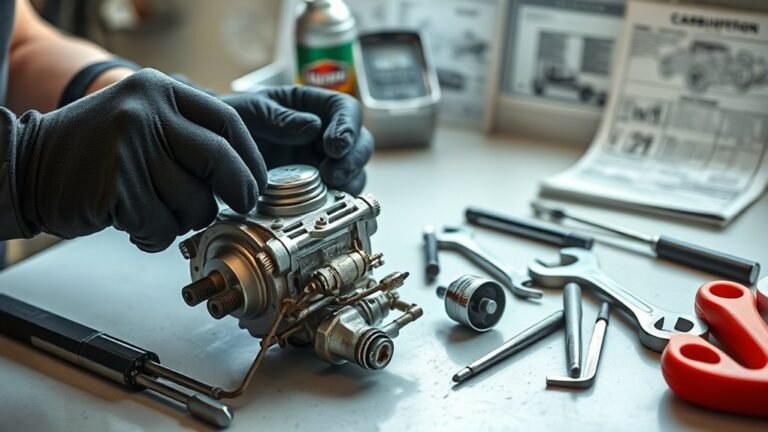
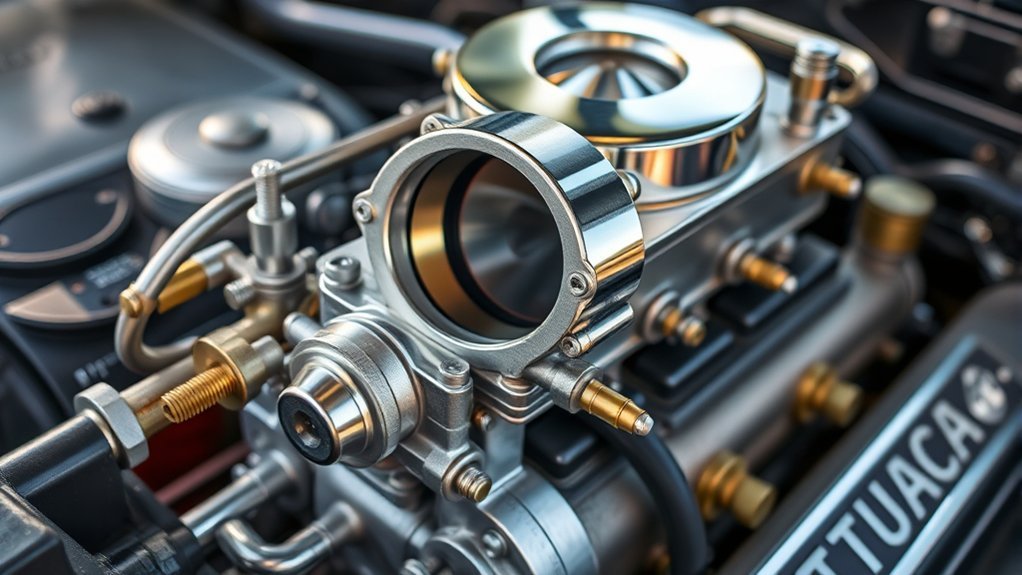
A carburetor is a compact, metallic device usually mounted atop the engine’s intake manifold. It plays a crucial role in mixing fuel and air for the engine to run efficiently. You’ll notice a boxy structure with visible throttle linkages, a fuel inlet, and air intake openings.
It often features a cylindrical bore for airflow and an attached float chamber. On cars, the carburetor is larger with more components, while small engine carburetors are more compact but share key features. Understanding its design and parts reveals why it’s essential for fuel and air mixing in engines.
What a Carburetor Looks Like
What exactly does a carburetor look like? When you examine one, you’ll notice a compact, metallic component, typically made from aluminum or zinc alloy, with a somewhat boxy yet intricate structure. Its carburetor aesthetics are defined by a series of tubes, linkages, and chambers arranged symmetrically.
For visual identification, focus on the throttle lever, fuel inlet, and air intake openings. The body often features a cylindrical bore through which air flows. Various screws and adjustment points are visible, designed for tuning fuel-air mixture.
You’ll also see mounting flanges for attachment to the engine. Though sizes and shapes vary slightly by model, the essential configuration remains consistent, allowing you to distinguish a carburetor clearly amidst other engine parts by these characteristic visual cues.
Main Carburetor Parts
You’ll find the main carburetor parts include the float chamber, throttle plate, venturi, and jets, each critical for proper fuel-air mixing. The float chamber regulates fuel flow, while the venturi creates the necessary pressure drop to draw fuel into the airflow.
Understanding how each component functions helps you grasp how the carburetor controls engine performance.
Key Components Overview
How does each part of a carburetor contribute to its function? Understanding the key components is essential to grasp the overall mechanism shaped by carburetor history and fuel delivery evolution.
You’ll find the float chamber, which regulates fuel level, ensuring consistent delivery. The venturi narrows airflow, increasing velocity and reducing pressure to draw fuel into the airstream.
The throttle valve controls airflow volume, directly affecting engine speed. Jets precisely meter fuel, essential for the correct air-fuel ratio.
Additionally, the choke valve restricts air for cold starts, improving fuel vaporization. Together, these components form a complex system finely tuned over decades, reflecting advancements in fuel delivery evolution.
Function Of Each Part
Typically, each main carburetor part performs a specific, critical function that guarantees proper air-fuel mixture delivery to the engine. The float chamber regulates fuel level, maintaining consistent pressure for optimal carburetor efficiency.
The venturi narrows the airflow path, increasing velocity and lowering pressure to draw fuel into the airstream. The throttle valve controls engine speed by adjusting airflow volume, directly influencing the fuel air mixture ratio.
Jets meter precise fuel quantities, ensuring the mixture remains balanced under varying engine loads. The choke valve enriches the mixture during cold starts by restricting airflow.
Understanding these functions helps you appreciate how each component works in harmony to optimize combustion, ensuring your engine runs smoothly and efficiently by delivering the ideal fuel air mixture at all times.
How a Carburetor’s Shape Affects Its Function
Why does the shape of a carburetor matter so much to its performance? The carburetor’s geometry directly influences fuel atomization and airflow dynamics. Its venturi shape accelerates incoming air, lowering pressure to draw shielded fuel efficiently from the jet, preventing vapor lock and ensuring consistent delivery.
The precise contour of the throttle bore modulates the idle mixture, allowing fine control of fuel-to-air ratio at low speeds. Additionally, the shape of fuel passages and float chamber affects fuel shielding, minimizing turbulence and maintaining stable flow.
When you consider the interplay of curved surfaces and angles, you realize how critical design is for optimizing combustion. In short, each curve and contour is engineered to balance airflow velocity and fuel metering, ensuring smooth engine operation across all conditions.
Tips to Quickly Recognize a Carburetor
Understanding the carburetor’s shape and function lays the groundwork for recognizing one quickly in various engine setups. To identify a carburetor despite its varied aesthetics and potential misleading labels, focus on these three technical cues:
- Air Intake and Throttle Linkage: Look for a distinct air intake housing connected to a throttle linkage mechanism, which controls airflow precisely.
- Fuel Bowl Presence: Spot the fuel bowl, a small chamber usually attached to the side, indicative of the carburetor’s fuel metering function.
- Choke Mechanism: Identify the choke assembly, often a butterfly valve near the air intake, designed to regulate air-fuel mixture during cold starts.
Common Carburetor Designs Explained
You’ll encounter three main carburetor designs: single barrel, two barrel, and four barrel configurations. Each type controls airflow and fuel delivery with varying complexity to match engine demands.
Understanding these differences helps you identify their specific functions and applications.
Single Barrel Carburetors
How does a single barrel carburetor manage air-fuel mixture delivery with such simplicity? It relies on a single venturi passage that precisely meters fuel into the incoming air stream, ensuring efficient combustion. You’ll notice its compact design significantly influences carburetor aesthetics, appealing to those favoring minimalism.
Key functional aspects include:
- Throttle Plate Control: Regulates airflow volume, directly impacting engine speed and power output.
- Fuel Jet Calibration: Precisely meters fuel flow based on engine demand, maintaining optimal air-fuel ratios.
- Choke Mechanism: Enriches the mixture during cold starts by restricting airflow temporarily.
For those considering aftermarket mods, single barrel carburetors offer straightforward upgrades, such as improved jets or enhanced choke assemblies, without compromising their simple and efficient design.
Two Barrel Configurations
Why opt for a two barrel carburetor instead of a single barrel? Two barrel configurations enhance fuel-air mixture control, improving engine tuning flexibility and response. They allow one barrel to handle low-speed operation while the second opens during higher demand, optimizing fuel efficiency and reducing emissions, addressing environmental concerns effectively.
| Feature | Benefit |
|---|---|
| Dual throttle plates | Improved fuel delivery precision |
| Separate fuel circuits | Enhanced low/high RPM performance |
| Progressive opening | Better throttle response |
| Reduced emissions | Meets stricter environmental norms |
This setup balances power and economy, making it ideal for engines needing precise tuning without sacrificing environmental compliance. You’ll find two barrel carburetors common in vehicles aiming to meet stricter emissions standards while maintaining reliable performance.
Four Barrel Designs
A four barrel carburetor features two primary and two secondary barrels, designed to deliver enhanced fuel and air flow for high-performance engines. When you examine its design, you’ll notice the carburetor aesthetics emphasize symmetry and functional complexity.
The manufacturing processes involve precision casting and machining to maintain tight tolerances, ensuring optimal fuel atomization.
Here are three key aspects to understand:
- Primary barrels handle regular engine operation, providing fuel efficiency and smooth throttle response.
- Secondary barrels activate during high demand, increasing airflow and fuel delivery for power surges.
- Linkage mechanisms coordinate barrel operation seamlessly, balancing performance and drivability.
This design enhances volumetric efficiency and responsiveness, making four barrel carburetors a staple in muscle cars and racing applications.
Identifying Carburetors on Cars and Small Engines
Where exactly can you spot a carburetor when examining cars and small engines? Typically, it’s mounted atop the intake manifold, directly above the engine block. On cars, the carburetor aesthetics reveal a metallic body with visible linkages and fuel lines, often accompanied by an air filter housing.
Small engines, like those on lawnmowers, feature simpler, more compact carburetors, usually accessible near the engine’s side. To identify it precisely, look for the throttle linkage and fuel inlet. Understanding ignition timing helps here: carburetors regulate the air-fuel mixture critical to maintaining proper timing for combustion efficiency.
Frequently Asked Questions
How Do Carburetors Compare to Fuel Injection Systems?
You’ll find carburetors, with their classic, mechanical aesthetics, rely on simple fuel metering concepts, while fuel injection systems use precise electronic controls, improving efficiency by up to 15%.
They optimize fuel delivery and reduce emissions substantially.
What Maintenance Is Required for Carburetors?
You’ll need regular carburetor maintenance, including cleaning jets and float bowls, adjusting idle and mixture screws, and ensuring fuel system cleanliness to prevent clogs.
Inspect gaskets and linkages for wear to keep optimal performance and fuel efficiency.
Can Carburetors Be Used With Alternative Fuels?
Yes, you can use carburetors with alternative fuels, but you’ll need precise carburetor adaptation. This involves adjusting jet sizes, float levels, and sometimes materials to ensure proper fuel-air mixture and prevent corrosion or clogging.
How Do Carburetors Affect Engine Performance?
You’ll notice carburetor efficiency directly impacts engine performance by controlling fuel air ratio adjustments, ensuring optimal combustion.
Precise tuning prevents power loss, improves throttle response, and reduces emissions, making your engine run smoothly and efficiently.
What Are Common Carburetor Troubleshooting Tips?
Picture a steady engine hum; start by checking idle adjustment screws for smooth revs. Inspect float chamber issues. Stuck floats cause flooding or starvation.
Clean jets meticulously, ensuring no debris blocks fuel flow, maintaining precise carburetor function.