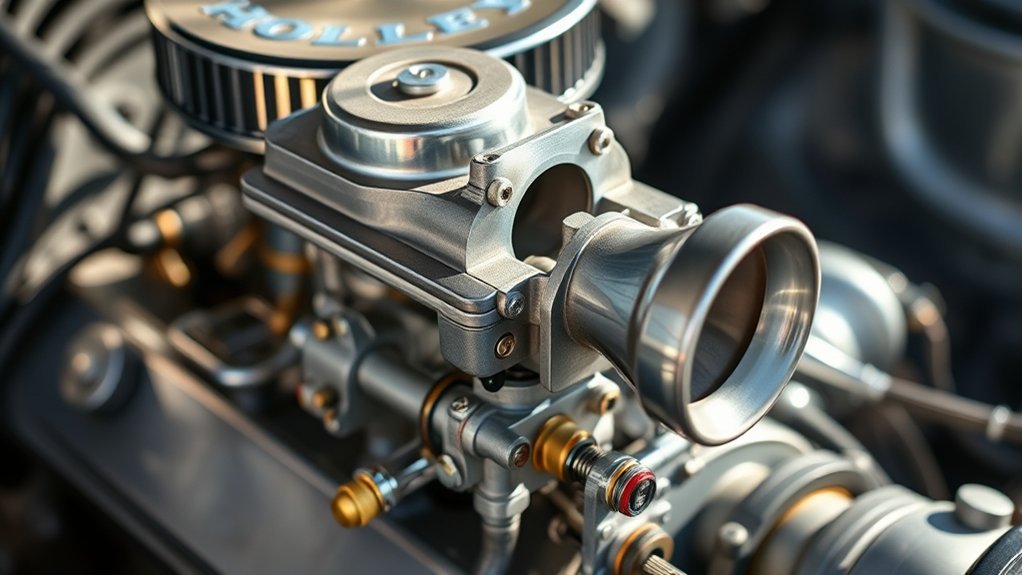
How to Identify a Holley Carburetor
To identify a Holley carburetor, start by looking for stamped model numbers and four-digit date codes on the main body or fuel bowl, typically near the throttle lever. Verify the sharp “Holley” logo cast into metal with clear edges and consistent ribbing patterns.
Check for compact dual throttle bores and patented secondary throttle systems designed for efficient fuel delivery. Confirm metal quality and precise machining to rule out counterfeits.
These steps provide a solid start; understanding deeper authenticity cues and series details will clarify further.
Finding Holley Model Numbers and Date Codes
Where exactly can you find the model numbers and date codes on a Holley carburetor? Typically, you’ll locate these crucial identifiers on the carburetor’s main body, often on the passenger side near the throttle lever or on the fuel bowl.
For finding numbers, look for stamped or cast digits; Holley usually marks the model number plainly, while the date code may be a four-digit sequence. When decoding codes, understand the date code usually indicates the production week and year, formatted as WWYY or similar.
Use a Holley reference chart to translate these numbers accurately. Precise identification relies on clean surfaces for readability; remove dirt or paint carefully to avoid erasing vital information. This method ensures you’re decoding codes correctly for authenticity and compatibility verification.
What Sets Holley Carburetors Apart?
After locating and decoding the model numbers and date codes on a Holley carburetor, you gain insight into its production specifics, but understanding what truly distinguishes Holley carburetors requires examining their design and performance features.
Rooted in Holley history, these carburetors are engineered for consistent fuel atomization and airflow efficiency, setting them apart from competitors. They utilize innovative metering blocks and interchangeable jets, allowing precise tuning for varied engine demands.
Engineered for precise fuel atomization and airflow, Holley carburetors enable expert tuning for diverse engine needs.
Despite common carburetor myths suggesting complexity or unreliability, Holley’s design emphasizes serviceability and adaptability. Their reputation for durability comes from robust materials and a patented secondary throttle system that optimizes fuel delivery under load.
Recognizing these technical advantages helps you appreciate why Holley remains a preferred choice among performance enthusiasts and restorers alike.
How to Spot Key Physical Features of Holley Carburetors
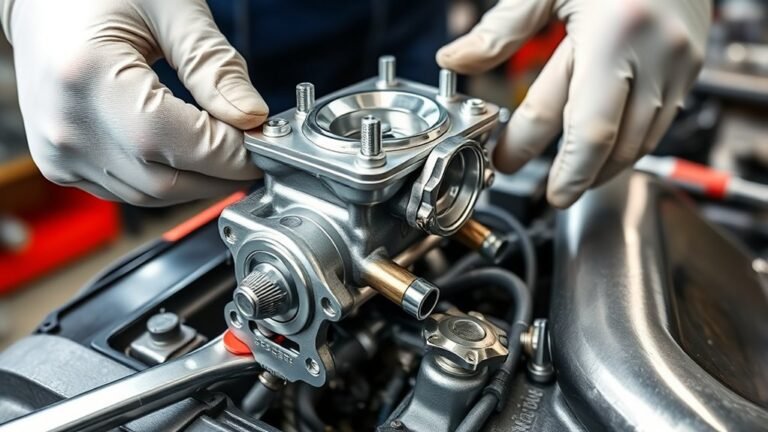
You’ll want to start by examining the body shape, as Holley carburetors have a distinctive, compact design with dual throttle bores.
Next, look closely for specific markings and stamps. These include model numbers, casting dates, and the Holley logo, usually found on the throttle body or float bowl.
Identifying these physical traits helps confirm authenticity and narrows down the exact model you’re dealing with.
Recognizing Distinctive Body Shape
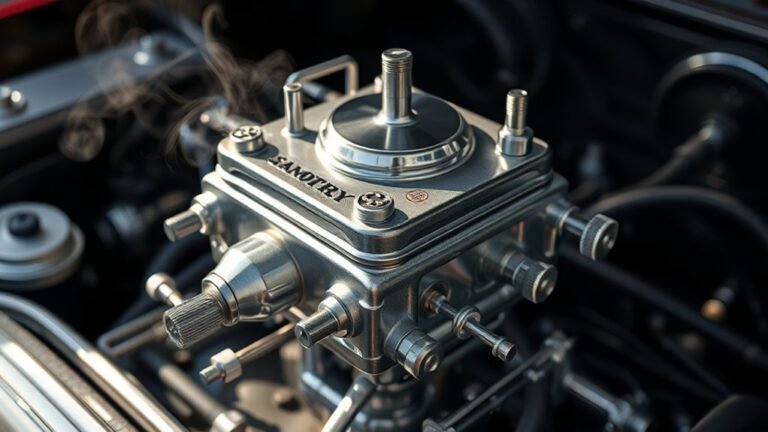
How can you quickly distinguish a Holley carburetor from others just by its shape? Focus on the symmetrical, square-like main body with two prominent, rounded fuel bowls on either side. The throttle bore size is noticeably uniform and smooth, typically ranging from 4150 to 4160 models.
When recognizing counterfeit units, carefully evaluate paintwork quality. Authentic Holleys have consistent, durable finishes without uneven spraying or drips. The linkage arms and fuel inlet are neatly integrated, with precise casting lines and minimal flash.
Pay attention to the metering block’s compact design; genuine Holleys avoid bulky or asymmetrical shapes here. These details in body shape, combined with evaluating paintwork, help you identify authentic Holley carburetors confidently, minimizing the risk of counterfeit parts in your inventory.
Identifying Markings And Stamps
Where exactly should you look to verify a Holley carburetor’s authenticity? Focus on the cast body’s markings and stamped numbers. Genuine Holleys feature distinct logos, part numbers, and date codes precisely placed.
Identification myths often confuse placement and font styles, but counterfeit indicators include inconsistent stamping depth, misspelled logos, or unusual fonts.
| Marking Location | Authentic Features |
|---|---|
| Front Face | Clear “Holley” logo |
| Base Plate | Stamped part and date codes |
| Choke Housing | Model number embossing |
| Float Bowl | Consistent casting marks |
How to Recognize Genuine Holley Casting Marks and Logos
A key step in verifying a Holley carburetor involves examining the casting marks and logos embedded in its body. You should look for an authentic casting that features a distinct “Holley” name cast directly into the metal, usually on the main body or throttle housing.
The logo verification process requires confirming the presence of a raised or recessed Holley script, which is sharp and clear, rather than shallow or blurred. Pay attention to the casting’s texture and weight, as genuine Holley castings have precise mold details and a consistent finish.
Additionally, authentic castings often include a unique pattern of ribbing or reinforcing lines around the logo area, which counterfeit parts frequently lack. These subtle yet crucial details help ensure you’re dealing with a legitimate Holley carburetor.
How to Identify Different Holley Carburetor Series and Types
To identify different Holley carburetor series and types, you’ll need to focus on the model numbers stamped on the main body, which indicate the specific series and specifications. Additionally, pay close attention to physical features like the shape of the fuel bowls, throttle linkage design, and venturi size, as these vary between models.
Understanding these details will help you accurately classify the carburetor’s series and intended application.
Recognizing Model Numbers
How can you quickly determine which Holley carburetor series you’re working with? Start by locating the model numbers stamped on the carburetor’s body, typically on the base or throttle plate. These numbers are crucial identifiers linking the carburetor to specific series and types.
Alongside model numbers, check for date codes, usually a combination of letters and numbers, that indicate manufacturing dates, aiding in authenticity verification. Cross-referencing these codes with Holley’s official documentation or databases ensures you’re dealing with genuine parts and helps distinguish between original equipment and aftermarket versions.
Accurate recognition of model numbers and date codes not only confirms the carburetor’s series but also supports proper maintenance and compatibility decisions, making it an essential step in your identification process.
Identifying Physical Features
Where should you look when trying to distinguish between different Holley carburetor series and types? Start by examining the physical features closely. Identifying color schemes is crucial; many Holley carburetors use specific paint colors or finishes, like black wrinkle or silver, that correspond to particular series or production years.
Next, focus on distinguishing valve covers, as their shape, bolt patterns, and markings often differ between models. Pay attention to casting differences on the throttle body and fuel bowl, which can indicate the carburetor’s series. Also, note the presence or absence of choke mechanisms and linkage types.
How to Check If Holley Carburetor Parts Are Genuine
Ensuring the authenticity of Holley carburetor parts requires close examination of specific features unique to genuine components. Start by inspecting the casting quality; authentic parts exhibit sharp, consistent edges and clearly defined Holley logos.
Check for part numbers stamped or cast into the metal, matching official Holley documentation. Beware of carburetor counterfeit parts that often have irregular fonts or misspelled markings.
Authentication methods include verifying serial numbers through Holley’s official database or authorized dealers. Additionally, examine the finish—authentic parts have uniform coatings without rough spots or discoloration.
If possible, compare parts side-by-side with verified originals to detect subtle differences. Employing magnification tools helps identify inconsistencies invisible to the naked eye.
Rigorous application of these checks ensures you avoid counterfeit components and maintain performance integrity.
Parts That Look Like Holleys But Aren’t
Even after verifying genuine Holley parts, you might come across components that closely resemble Holley carburetors but differ considerably in design and performance. These generic counterfeit units often use imitation branding to mimic Holley’s distinctive markings, making visual identification challenging.
Non Holley components may exhibit subtle variations, such as imprecise casting details, incorrect bolt patterns, or inferior metal quality. Dubious aftermarket parts frequently lack the engineering tolerances and material integrity Holley maintains, resulting in compromised fuel delivery and reliability.
When inspecting suspected parts, focus on machining precision, serial number fonts, and the presence of authentic Holley logos. Understanding these differences helps you avoid costly mistakes by distinguishing true Holley carburetors from look-alike but fundamentally different products that fail to meet Holley’s stringent standards.
Tips for Confirming Authenticity When Buying Used Holleys
How can you be certain a used Holley carburetor is genuine before making a purchase? First, verify authentic pricing by comparing the seller’s asking price with market values for similar Holley models. Unrealistically low prices often indicate counterfeit or rebranded units.
Next, demand seller transparency: request clear photos showing casting numbers, date codes, and manufacturer stamps. Authentic Holleys have distinct markings on the throttle body and fuel bowls. Inspect these details closely for consistency.
Additionally, ask for the carburetor’s history, including prior usage and maintenance records. If possible, cross-reference serial numbers with Holley’s official database.
Finally, test the carburetor’s mechanical functionality if feasible. These steps ensure you avoid replicas and secure a true Holley, preserving performance and value.
Frequently Asked Questions
How Often Should I Rebuild My Holley Carburetor?
You should schedule a solid rebuild interval every 25,000 to 30,000 miles, sticking strictly to the maintenance schedule.
Regularly reviewing and replacing worn parts preserves performance, prevents problems, and promotes precise, peak carburetor operation.
What Tools Are Needed for Holley Carburetor Maintenance?
You’ll need a basic socket set, screwdrivers, carburetor cleaner, a fuel pressure gauge, and a gasket scraper. For inspection, use a magnifying glass to check wear.
Following maintenance tips guarantees enhanced performance and longevity.
Can Holley Carburetors Be Used With Ethanol-Blended Fuel?
Yes, Holley carburetors have ethanol compatibility but require specific adjustments for fuel blends containing ethanol. You’ll need to check seals, gaskets, and jets to ensure optimal performance and prevent degradation caused by ethanol’s corrosive properties.
How Does Altitude Affect Holley Carburetor Tuning?
You’ll need altitude tuning because air density decreases with elevation, causing your Holley carburetor to run rich. Adjust jet sizes and air bleeds precisely to maintain optimal air-fuel ratios and engine performance at higher altitudes.
What Are Common Performance Upgrades for Holley Carburetors?
You’ll want to upgrade jets, improve upstream airflow with larger boosters, and install high-performance air bleeds.
Precise idle adjustments and stronger accelerator pumps also enhance throttle response and overall Holley carburetor efficiency.