What Carburetor
A carburetor is a mechanical device that mixes air and fuel for your engine’s combustion, directly affecting its performance and efficiency. The carburetor uses the venturi effect to draw fuel into the airstream, balanced by components like the throttle valve, venturi, fuel jets, and float chamber.
Though less precise than modern fuel injection, carburetors remain essential in understanding engine basics. Explore the different types, key parts, and why many vehicles have shifted away from carburetors.
What Is a Carburetor and Why It Matters
What exactly is a carburetor, and why should you care about it? A carburetor is a mechanical device designed to mix air and fuel in precise ratios for internal combustion engines. Understanding its role is essential because it directly influences engine performance and efficiency.
The carburetor history dates back to the late 19th century, evolving from rudimentary fuel delivery systems to complex mechanisms that optimized combustion. Despite advances in fuel injection, many fuel economy myths persist around carburetors, such as the belief that they inherently waste fuel.
In reality, a well-maintained carburetor can provide efficient fuel delivery, but poor adjustment or wear can reduce economy. Recognizing the carburetor’s function helps you appreciate its impact on engine reliability and dispels misconceptions about its efficiency.
How a Carburetor Mixes Air and Fuel for Combustion
How does a carburetor achieve the precise balance of air and fuel necessary for efficient combustion? Drawing from carburetor history, this balance is maintained by controlling airflow velocity and fuel delivery through venturi effect principles. As air passes through a narrowed section, pressure drops, drawing fuel into the airstream.
A carburetor balances air and fuel using the venturi effect to enable efficient combustion.
You’ll find this process depends on four key components:
- Throttle valve regulates air volume.
- Venturi creates pressure differential to pull fuel.
- Fuel jets meter the fuel flow precisely.
- Float chamber maintains consistent fuel level.
This system manages fuel economy trade offs by adjusting ratios for varying engine loads. While efficient, it can’t match modern fuel injection precision, but it remains a fundamental mechanical method for achieving combustion-ready mixtures.
Common Types of Carburetors Used in Engines
Understanding the basic operation of a carburetor sets the stage for recognizing the various designs tailored to different engine requirements. You’ll encounter several common types, each reflecting evolving carburetor history.
The float-type carburetor, prevalent in vintage designs, uses a float chamber to maintain fuel level, ensuring steady delivery. Another frequent type is the fixed-venturi carburetor, which relies on a fixed opening to regulate airflow and fuel mixture.
You might also see variable-venturi carburetors, which adjust the venturi size dynamically for improved efficiency. Each design addresses specific needs, from simplicity and reliability in older models to enhanced performance in more advanced engines.
Carburetor Parts and Their Functions
Now, you’ll examine the main carburetor components and their specific functions. Understanding parts like the float chamber, throttle valve, and venturi is essential to grasp how fuel and air mix efficiently.
This knowledge helps you diagnose issues and optimize engine performance.
Main Carburetor Components
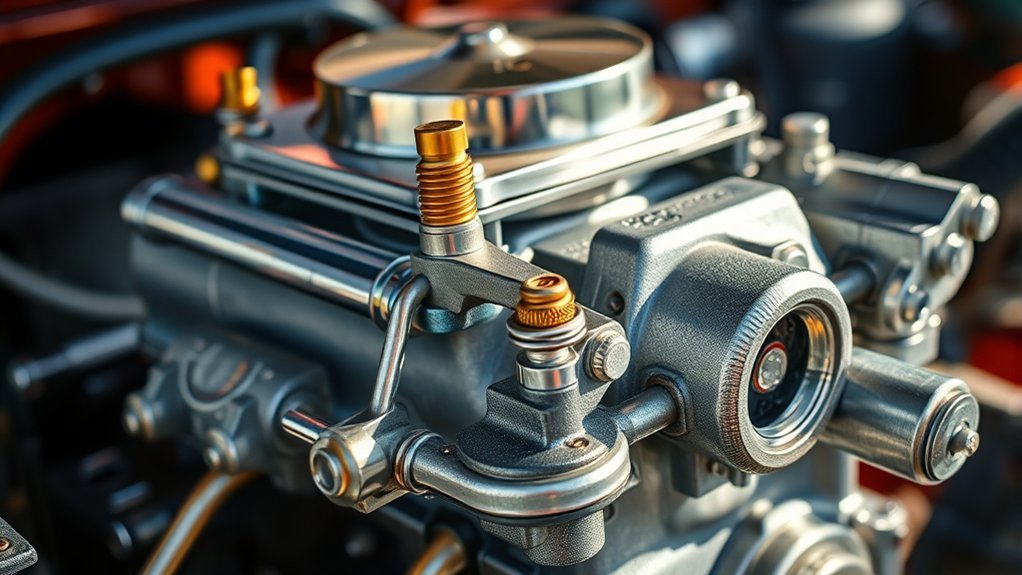
A carburetor consists of several key components that work together to mix air and fuel in the correct proportions for combustion. Understanding these parts helps clear up common carburetor myths and guides effective maintenance routines. The main components include:
- Throttle Valve Controls airflow into the engine.
- Float Chamber Maintains a consistent fuel level.
- Venturi Narrows the airflow path to increase velocity and draw fuel.
- Jets Meter the fuel flow into the airflow stream.
Each component’s precise role is critical for optimal performance. Proper knowledge of these parts allows you to perform targeted maintenance, avoiding unnecessary adjustments driven by misinformation. This foundational understanding sets the stage for grasping the function of each part in detail.
Function of Each Part
Each main component of the carburetor plays a specific role in regulating the air-fuel mixture for efficient combustion. The float chamber maintains a steady fuel level, ensuring consistent delivery. The throttle valve controls airflow, directly influencing engine speed and power.
The venturi creates a pressure drop, drawing fuel into the airstream. Needles and jets meter fuel flow precisely, enabling dynamic tuning based on engine demands. Choke valves enrich the mixture for cold starts.
Modern design processes often utilize virtual simulations to optimize these parts’ interactions before physical testing, improving efficiency and reducing trial and error. By understanding each part’s function and their integration, you can appreciate how carburetors achieve precise air-fuel ratios essential for performance and emissions control.
Signs Your Carburetor Needs Cleaning or Repair
If your engine experiences rough idling, hesitation, or stalling, your carburetor might need cleaning or repair. You should also inspect for visible signs like fuel leaks, corrosion, or buildup on the carburetor body.
Recognizing these indicators early helps maintain optimal engine performance and prevents further damage.
Engine Performance Issues
When your engine starts exhibiting irregular idling, hesitation during acceleration, or reduced fuel efficiency, it often indicates that the carburetor requires cleaning or repair. Neglecting these symptoms can accelerate engine wear and degrade fuel economy.
You should monitor for these specific performance issues:
- Rough or fluctuating idle speeds
- Delayed throttle response or engine hesitation
- Increased fuel consumption despite normal driving habits
- Engine stalling or surging during operation
These signs reveal fuel-air mixture inconsistencies caused by carburetor deposits or mechanical faults. Addressing them promptly ensures optimal combustion, minimizes engine wear, and restores efficient fuel economy.
If you notice any of these symptoms, inspecting and servicing the carburetor is essential to maintain your engine’s reliability and performance.
Visible Carburetor Problems
How can you tell if your carburetor needs cleaning or repair just by looking? A careful visual examination reveals common signs rooted in carburetor history. Dirt buildup, corrosion, or fuel leaks indicate trouble. These visible problems directly affect engine efficiency and demand prompt attention.
| Symptom | Emotional Impact |
|---|---|
| Dirt accumulation | Frustration |
| Corroded parts | Anxiety |
| Fuel leaks | Urgency |
| Black smoke | Concern |
| Sticking throttle | Irritation |
Each symptom reflects mechanical distress. Dirt and corrosion reduce airflow and fuel mixture quality, while leaks pose safety risks. Black smoke signals improper combustion, and sticking throttles hinder control. Recognizing these signs early through visual examination helps you act decisively, preserving performance and preventing costly repairs.
Why Carburetors Are Being Replaced by Fuel Injection
Why have carburetors gradually been supplanted by fuel injection systems in modern engines? Understanding carburetor history reveals their mechanical simplicity, but also inherent limitations in fuel metering precision. Fuel system evolution aimed for enhanced efficiency, emissions control, and reliability, goals better met by fuel injection.
You’ll find fuel injection offers:
- Precise fuel delivery controlled electronically for optimal combustion.
- Improved fuel efficiency through adaptive adjustments based on engine conditions.
- Reduced emissions by maintaining ideal air-fuel ratios consistently.
- Enhanced engine responsiveness and easier cold starts.
Unlike carburetors, fuel injection systems integrate sensors and computer controls, eliminating manual tuning. This evolution reflects the automotive industry’s push towards performance optimization and regulatory compliance, making carburetors increasingly obsolete in modern vehicles.
Frequently Asked Questions
Can Carburetors Be Tuned for Racing Performance?
Yes, you can optimize carburetor tuning for racing performance by adjusting jet sizes, needle positions, and air-fuel mixtures. This enhances throttle response, power output, and fuel efficiency under high RPM, ensuring precise engine calibration.
How Do Altitude Changes Affect Carburetor Function?
You’ll notice altitude changes affect carburetor function by altering air density, requiring altitude compensation to maintain the correct fuel air ratio. Without it, your engine runs rich or lean, impacting performance and efficiency considerably.
What Tools Are Needed for Carburetor Adjustment?
You’ll need screwdrivers, a socket set, and a tachometer for carburetor adjustment. Understanding carburetor basics guarantees tool compatibility, letting you precisely tune idle and mixture screws to optimize engine performance and fuel efficiency.
Are Carburetors Compatible With Alternative Fuels?
You’ll find fuel compatibility varies; some carburetors handle alternative fuels well, while others don’t. Adjustments must consider altitude effects on air-fuel mixture, ensuring optimal combustion and performance under different environmental conditions.
How Long Does a Typical Carburetor Last?
You can expect carburetor longevity to range from 10 to 15 years, depending on maintenance and fuel system health.
Regular cleaning and proper fuel quality substantially extend its operational lifespan and guarantee consistent engine performance.