
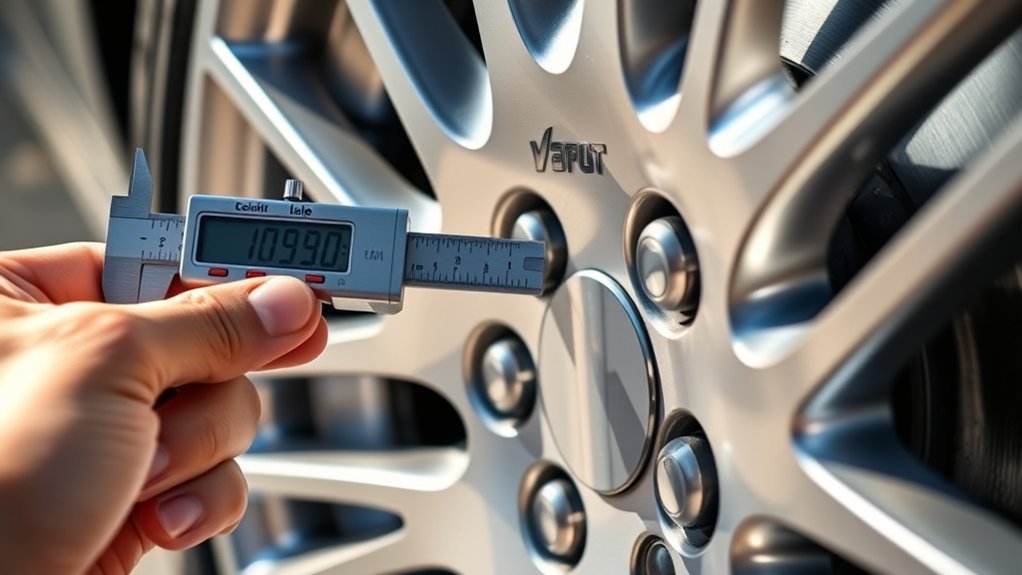
How Do You Measure Wheel Lug Pattern
To measure your wheel lug pattern, first count the number of lug holes on your wheel. The lug pattern is a crucial specification for fitting wheels correctly.
For an even number of lugs, measure the center-to-center distance between two opposite holes. If your wheel has an odd number of lugs, measure from the center of one lug hole to the outer edge of the lug directly across.
Use a ruler or caliper for accuracy and record both the lug count and distance in millimeters or inches. Keep following for tips on matching wheels and avoiding common mistakes.
Key Takeaways
- Count the total number of lug holes evenly spaced around the wheel center to determine lug count.
- For even-numbered lugs, measure the center-to-center distance between two opposite lug holes.
- For odd-numbered lugs, measure from the center of one lug hole to the outer edge of the opposite lug hole.
- Use a ruler, measuring tape, or caliper for precise measurements in millimeters or inches.
- Record and double-check both lug count and diameter to ensure accurate wheel compatibility.
What Is a Wheel Lug Pattern and How to Identify Your Lug Count
What exactly is a wheel lug pattern, and why does it matter? Your wheel lug pattern is the arrangement and number of lug holes that secure the wheel to your vehicle’s hub. It ensures your wheels fit properly and stay safely attached while driving.
To identify your lug count, simply count the number of lug holes on your wheel. Most cars have either four, five, or six lugs, but some trucks or SUVs might have more.
Knowing your lug count is essential because it helps you find compatible wheels and avoid costly mistakes. Without the correct pattern, your wheels won’t mount properly, risking damage or unsafe driving conditions.
Tools You Need to Measure Your Wheel Lug Pattern
After you’ve counted the number of lug holes, the next step is to measure the exact spacing of your wheel lug pattern. To do this accurately, you’ll need a few essential tools.
Start with a measuring tape or a ruler that has clear, precise markings in millimeters or inches. A caliper can be even better for accuracy, especially if you want to measure from the center of one lug hole to another.
You might also want a pen and paper to jot down your measurements. If your wheel has an odd number of lugs, a straight edge or a flexible tape measure helps when measuring across the wheel.
Having these tools ready ensures you’ll get a precise measurement without guesswork.
Step-by-Step Guide to Measuring Your Wheel Lug Pattern
Once you’ve gathered your tools, you can start measuring your wheel lug pattern by identifying the number of lug holes and accurately determining the distance between them. Here’s how to get it right:
Start by counting your wheel’s lug holes and measuring the precise distance between them for an accurate lug pattern.
- Count the lug holes: Check your wheel and count all the lug holes evenly spaced around the center. This number is essential.
- Measure the center-to-center distance: Use your ruler or caliper to measure from the center of one lug hole directly across to the center of the opposite hole (if even number) or to the edge of the nearest hole (if odd number).
- Record your measurements: Write down both the number of lugs and the distance in millimeters or inches, depending on your preference.
Following these steps guarantees you accurately capture your wheel’s lug pattern.
Measuring Lug Spacing for 4- and 5-Lug Wheels
Wondering how to measure lug spacing on 4- and 5-lug wheels? For 4-lug wheels, simply measure the distance between two opposite lug holes. This direct measurement gives you the lug spacing.
When it comes to 5-lug wheels, it’s a bit different since the holes don’t line up directly across from one another. Measure from the center of one lug hole to the outer edge of the lug hole directly across the circle. This gives you an accurate lug spacing diameter.
Using a ruler or caliper ensures precision. Remember, accurately measuring lug spacing helps you find the right wheels and avoid fitment issues. Once you get the hang of it, measuring 4- and 5-lug patterns becomes quick and straightforward.
Common Measurement Mistakes and How to Avoid Them
Why do measurement errors happen so often when checking your lug pattern? It’s usually because of small but critical mistakes that throw off your numbers. To avoid frustration, watch out for these common pitfalls:
Measurement errors in lug patterns often stem from small but crucial mistakes that skew your results.
- Measuring from the wrong points Always measure center-to-center of the lug holes, not edge-to-edge.
- Using inconsistent units Stick to either millimeters or inches throughout to prevent confusion.
- Ignoring wheel types Different lug counts require different measuring methods; mixing them up leads to errors.
How to Use Your Wheel Lug Pattern to Choose the Right Wheels
You’ll want to start by accurately identifying your wheel’s lug pattern measurements to ensure a perfect fit. Matching wheels to your specific lug pattern helps avoid compatibility issues and keeps your vehicle safe.
Let’s explore how to use these measurements to pick the right wheels for your ride.
Understanding Lug Pattern Measurements
How exactly do you use your wheel’s lug pattern to pick the right wheels? Understanding lug pattern measurements is key. Your lug pattern is defined by two numbers: the number of lug holes and the distance between them. Here’s how to grasp it quickly:
1. Count the Lug Holes
Identify how many bolts secure your wheel, usually 4, 5, or 6.
2. Measure the Diameter
Measure from the center of one lug hole to the center of the lug hole directly across (or use specific methods for odd numbers).
3. Match Precision
Your replacement wheel must match both the lug count and spacing exactly to fit safely.
Knowing these helps you avoid costly mistakes and ensures a secure, smooth ride every time.
Matching Wheels To Pattern
Two key factors, lug count and spacing, determine whether a wheel fits your vehicle. When choosing wheels, start by confirming your vehicle’s lug pattern matches the wheel’s bolt pattern exactly.
If the number of lugs or the distance between them doesn’t align, the wheel won’t mount properly, risking safety and performance. Use a reliable measuring method to find your lug count and spacing, then compare these specs with the wheels you want.
What to Do If Your Lug Pattern Isn’t a Standard Size
What steps can you take when your lug pattern doesn’t match a standard size? First, don’t panic. There are ways to handle this challenge. Here’s what you can do:
- Consult a professional mechanic or wheel expert. They can confirm your lug pattern and suggest compatible options or custom solutions.
- Consider custom wheels or adapters. Custom wheels are made to fit unique patterns, while adapters convert your lug pattern to a standard size, expanding your wheel choices.
- Double-check measurements carefully. Use precise tools to measure your lug pattern again, ensuring no mistakes that could lead to improper fitment.
Tips for Ensuring Safety and Proper Wheel Alignment
If your lug pattern isn’t standard, taking extra care with wheel fitment becomes even more important. First, always double-check your lug pattern measurements before installation. Incorrect fitment can lead to unsafe driving conditions.
Use proper torque settings to secure lug nuts evenly, preventing wheel wobble or damage. Also, get your wheel alignment checked regularly to maintain optimal handling and tire wear.
| Tip | Why It Matters | How To Do It |
|---|---|---|
| Measure twice | Ensures correct lug pattern | Use a reliable ruler or caliper |
| Use a torque wrench | Prevents over/under-tightening | Follow manufacturer specs |
| Check alignment | Improves safety and handling | Visit a trusted mechanic |
| Inspect lug nuts | Avoids loosening | Regularly re-tighten if needed |
| Replace damaged parts | Maintains wheel integrity | Swap out worn lug nuts/studs |
Frequently Asked Questions About Wheel Lug Patterns
You might wonder how to measure your wheel’s lug pattern correctly or what sizes are the most common. Knowing the right methods helps you avoid mistakes when selecting wheels.
Let’s answer these common questions to make the process easier for you.
Lug Pattern Measurement Methods
Measuring a wheel lug pattern can sometimes feel confusing, but getting it right is essential for proper fitment. Here’s how you can measure it accurately:
- Count the Lug Holes: First, count how many lug holes your wheel has, usually 4, 5, or 6. This number is crucial for identifying the pattern.
- Measure the Diameter: Use a ruler or caliper to measure the distance between the centers of two opposite lug holes (for even-numbered lugs) or from the center of one lug hole to the far edge of the opposite hole (for odd-numbered lugs). This gives you the diameter.
- Double Check Your Measurements: Confirm your numbers to avoid mistakes, ensuring your wheels fit safely and securely.
Common Lug Pattern Sizes
To make sure you get an accurate understanding of your wheel’s lug pattern, measure it precisely as the basis for determining compatible sizes for your vehicle. Common lug patterns vary, but you’ll often see patterns such as 4×100, 5×114.3, and 6×139.7.
The first number indicates how many lug holes there are, while the second denotes the diameter (in millimeters) of the circle those holes form. For instance, 5×114.3 means five lug nuts spaced evenly on a 114.3 mm circle.
Smaller cars typically have 4-lug or 5-lug patterns, whereas trucks and SUVs usually use 6- or 8-lug patterns. Being aware of these typical sizes helps you locate compatible wheels quickly and prevents mistakes when shopping.
Always double-check your measurements before purchasing to ensure a proper fit and a safe driving experience.
Frequently Asked Questions
Can Wheel Lug Patterns Affect Vehicle Handling and Performance?
Yes, wheel lug patterns can affect your vehicle’s handling and performance. Using the wrong pattern may cause improper fit, leading to vibration or imbalance.
Always ensure your wheels match the lug pattern for safe, smooth driving.
Are There Differences in Lug Patterns Between Front and Rear Wheels?
Think of your wheels as dancers in sync; usually, front and rear wheels share lug patterns for harmony. But sometimes, manufacturers change them to balance grip and strength, like choreographing moves to fit different roles on stage.
How Do Aftermarket Wheel Adapters Impact Lug Pattern Compatibility?
Aftermarket wheel adapters change your lug pattern, letting you fit wheels with different bolt patterns. You’ll need to guarantee the adapter’s pattern matches both your vehicle and the new wheels for safe, proper compatibility.
Can Weather Conditions Influence Lug Nut Tightness or Wheel Fit?
Yes, weather conditions can affect lug nut tightness and wheel fit. Temperature changes cause metal to expand or contract, so you should check and retighten lug nuts after extreme weather to ensure safety and proper fit.
Do Electric Vehicles Have Unique Wheel Lug Pattern Requirements?
Like a secret handshake, electric vehicles often have unique lug patterns to match their specific designs and weight distribution. You’ll want to check compatibility carefully, so your wheels fit perfectly and keep your ride smooth and safe.
Conclusion
Now that you know how to measure your wheel lug pattern accurately, you can confidently choose the right wheels for your vehicle. Remember, a precise fit means safer drives and better performance.
So, why risk a mismatch when a simple measurement can save you from costly mistakes? With the right tools and steps, you’re all set to keep your wheels aligned and your journeys smooth.
Ready to roll with confidence? Always rely on the correct wheel lug pattern measurement to ensure your wheels fit perfectly every time.