How to Tune a Carburetor
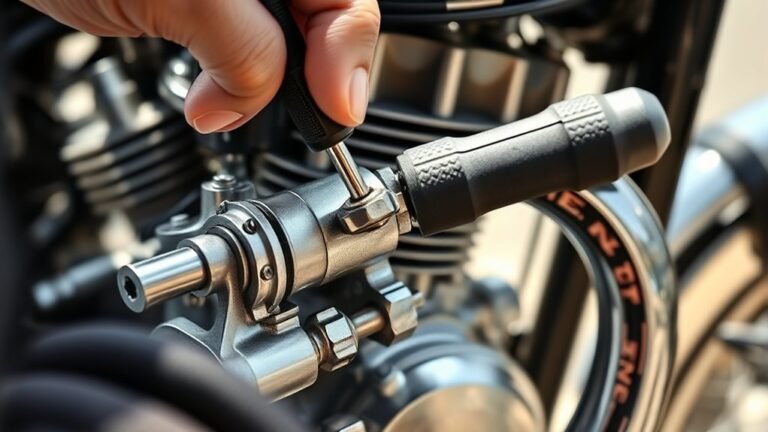
To tune your carburetor, first warm your engine to operating temperature.
Adjust the idle speed screw to set a stable idle without stalling, then fine-tune the air-fuel mixture screw—turn clockwise to lean, counterclockwise to enrich—using a tachometer for precision.
Check and set the float level to prevent flooding or fuel starvation.
Finally, ensure the choke plate fully closes when cold and opens smoothly.
Mastering these steps will help you optimize performance and efficiency with confidence.
What Is a Carburetor and How Does It Work?
How exactly does a carburetor function within an engine? It mixes air and fuel in precise ratios for combustion. Drawing from the carburetor history, this device was fundamental before fuel injection systems emerged.
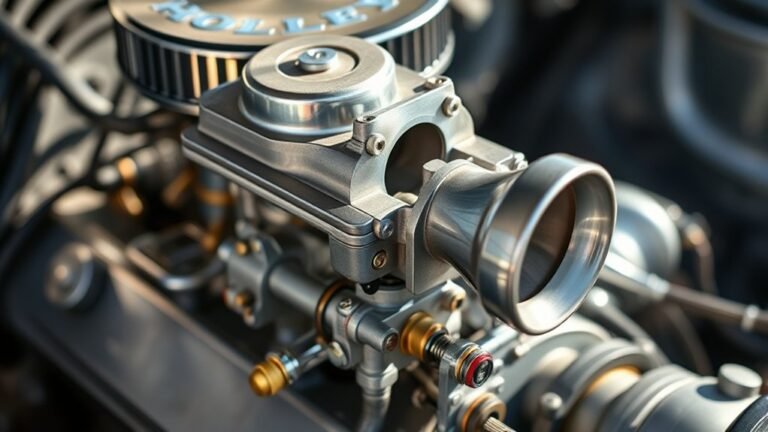
You’ll find that a carburetor uses a venturi to create a vacuum, pulling fuel into the airflow. It controls fuel delivery through jets and needles, adjusting for engine load and speed.
Despite the fuel injection debate favoring efficiency and emissions control, carburetors remain relevant in many applications due to simplicity and cost. Understanding this mechanism is essential before tuning, as it impacts engine performance directly.
You’ll need to grasp how air-fuel mixture adjustments affect combustion, ensuring your engine runs smoothly under various conditions.
Why Tune Your Carburetor?
Understanding the role of the carburetor in managing the air-fuel mixture sets the stage for tuning it effectively. You need to tune your carburetor to optimize engine performance, fuel efficiency, and reduce emissions.
This is especially vital for off road bikes and antique engines, which often face diverse operating conditions and wear over time. Proper tuning ensures smoother idling, better throttle response, and prevents engine damage caused by running too lean or rich.
| Issue | Symptom | Result |
|---|---|---|
| Lean mixture | Engine sputters | Overheating, power loss |
| Rich mixture | Black smoke | Fouled spark plugs |
| Idle misadjustment | Rough idling | Stalling |
| Clogged jets | Poor acceleration | Hesitation |
| Worn components | Poor fuel economy | Increased emissions |
Tools You Need for Carburetor Tuning
To tune your carburetor effectively, you’ll need specific tools like a screwdriver set, a vacuum gauge, and a tachometer for accurate adjustments.
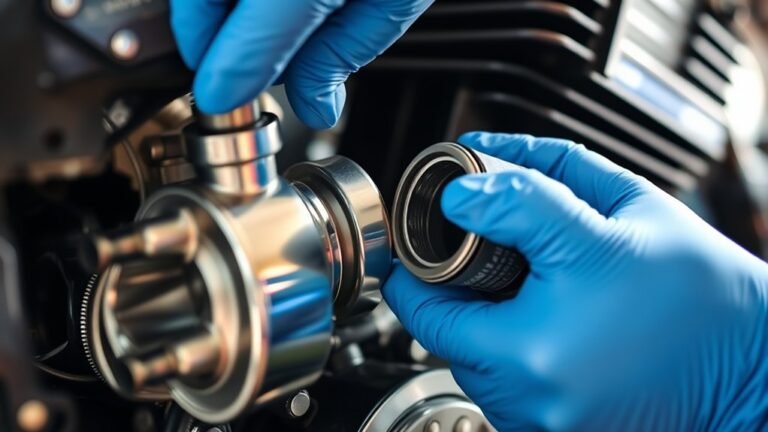
Having the right safety equipment, such as gloves and eye protection, is essential to prevent injury during the process. Let’s review these essential tools and safety measures before you start tuning.
Essential Tuning Tools
What tools do you need to effectively tune a carburetor? First, a reliable screwdriver set is essential for making precise universal adjustments to the idle and mixture screws.
You’ll also want a vacuum gauge to monitor engine vacuum changes, ensuring adjustments respond correctly to environmental considerations like altitude and temperature. A tachometer is crucial to measure RPMs accurately, helping you fine-tune for optimal performance.
Additionally, a fuel pressure gauge ensures your carburetor receives consistent fuel flow. Don’t overlook a clean, lint-free cloth to keep components free of debris during tuning.
These tools collectively allow you to make precise, repeatable adjustments, optimizing fuel-air mixture and idle speed tailored to your engine’s operating conditions. Having them on hand streamlines the tuning process and improves results.
Safety Equipment Needed
While having the right tools like screwdrivers and gauges is important for tuning a carburetor, ensuring your personal safety during the process is equally important. Carburetor tuning involves exposure to flammable gasoline, so preventing unsafe fuel handling and proper gasoline storage is critical.
You need to protect yourself from potential hazards like fuel spills, fumes, and accidental ignition.
Make sure you have the following safety equipment:
- Safety goggles to protect your eyes from fuel splashes
- Chemical-resistant gloves to avoid skin contact with gasoline
- A well-ventilated workspace to prevent fume buildup
- A fire extinguisher rated for flammable liquids nearby
- Proper gasoline storage containers that comply with safety standards
Using this equipment minimizes risk and allows you to tune your carburetor safely and effectively.
Spot the Key Parts of Your Carburetor
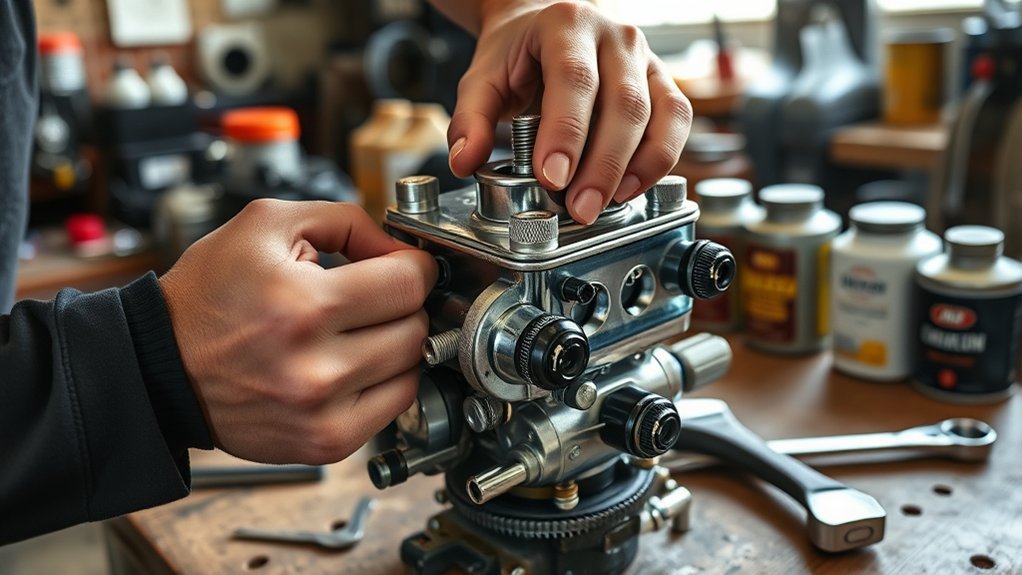
Before you start tuning, you need to identify the main components of your carburetor, including the float bowl, throttle plate, and choke. Understanding how fuel flows through these parts is essential for accurate adjustments.
Also, locate the idle and mixture screws, as these control critical settings during tuning.
Identifying Main Components
How do you recognize the essential parts of your carburetor? By identifying components systematically, you’ll better understand the carburetor layout and simplify tuning. Focus on the critical elements that control fuel and air mixture.
Key components include:
- Throttle Plate: Regulates airflow into the engine.
- Float Chamber: Maintains fuel level consistency.
- Main Jet: Controls fuel flow at higher speeds.
- Idle Jet: Manages fuel at idle.
- Choke Valve: Adjusts air intake during cold starts.
Familiarize yourself with these parts to accurately assess the carburetor’s condition. Recognizing each component’s position and function is fundamental before moving on to adjusting fuel flow or timing. This precision in identifying components ensures more effective tuning and troubleshooting.
Understanding Fuel Flow
Now that you can identify the main components of your carburetor, it’s important to understand how fuel moves through these parts. Fuel enters through the inlet, passing first through the fuel filtration system to remove contaminants that could clog jets or damage components.
From there, fuel travels into the float chamber, where the float regulates fuel level to maintain consistent flow. When you open the throttle, vacuum pressure draws fuel through the main jet and into the venturi, mixing with air to form a combustible mixture.
Be aware that vacuum leaks can disrupt this delicate balance, causing erratic fuel flow and poor engine performance. Proper fuel flow depends on intact seals and clean filtration, so inspect these areas closely before tuning your carburetor.
Recognizing Adjustment Screws
Where exactly are the adjustment screws located on your carburetor, and what roles do they play? Typically, you’ll find these screws near the base or side of the carburetor body. They regulate fuel-air mixture and idle speed, critical for optimal engine performance. Avoid getting distracted by absolutely irrelevant, unnecessary, or completely off topic details and unrelated discussions that don’t pertain to these screws.
Key points to recognize adjustment screws:
- Idle Mixture Screw: Controls fuel-to-air ratio at idle.
- Idle Speed Screw: Adjusts throttle plate position.
- Choke Adjustment Screw: Regulates choke plate movement.
- Accelerator Pump Screw: Modifies fuel delivery on acceleration.
- Throttle Stop Screw: Sets minimum throttle opening.
Identifying these ensures precise tuning and avoids guesswork.
How to Adjust Carburetor Idle Speed
Adjusting the carburetor idle speed is essential for ensuring your engine runs smoothly at low RPMs without stalling or running too fast. Start by warming up the engine to operating temperature.
Locate the idle speed screw, usually marked or near the throttle linkage. Turn it slowly clockwise to increase idle speed or counterclockwise to decrease it. Avoid confusing this with the fuel mixture screw.
| Step | Action |
|---|---|
| 1. Warm Engine | Run engine until fully warmed up |
| 2. Find Idle Speed Screw | Identify and access the correct screw |
| 3. Adjust Idle Speed | Turn screw clockwise to raise speed |
| 4. Check Engine Response | Ensure stable idle without stalling |
Keep the idle speed balanced to prevent rough idling; don’t alter the fuel mixture here.
How to Adjust the Air-Fuel Mixture
Once you’ve set a stable idle speed, the next focus is the air-fuel mixture, which directly affects engine performance and emissions. Adjusting this mixture ensures your engine runs efficiently without wasting fuel or producing excessive pollutants. Avoid getting distracted by unrelated topics or random debates about tuning methods; focus on precise adjustments.
To adjust the air-fuel mixture:
Locate the mixture screw on the carburetor.
Turn the screw slowly clockwise to lean the mixture.
Turn counterclockwise to enrich the mixture.
Use a tachometer or exhaust gas analyzer for accuracy.
Make small adjustments and allow the engine to stabilize before proceeding.
These steps optimize combustion, prevent engine knocking, and improve throttle response while minimizing emissions.
When and How to Adjust the Carburetor Float Level
You’ll need to adjust the carburetor float level when you notice fuel overflow or engine flooding. Use a caliper and a float gauge to measure the current level accurately.
Follow a step-by-step process to bend the float tab and set the level within the manufacturer’s specifications.
Float Level Importance
The float level in a carburetor directly controls the fuel height inside the float bowl, which is critical for maintaining the correct air-fuel mixture. If the float level is too high, fuel floods the jets, causing rich mixtures and rough idle speed. Conversely, a low float level starves the engine, leading to lean conditions and poor idle stability.
You need to adjust the float level precisely to ensure optimal engine performance and fuel efficiency.
Key reasons why float level matters:
- Maintains consistent fuel delivery at idle speed
- Prevents flooding or fuel starvation
- Affects throttle response and acceleration
- Influences emissions and fuel economy
- Ensures stable engine operation under varying loads
Always verify the float level against manufacturer specs before adjusting.
Tools Needed
How do you guarantee the float level adjustment is accurate and effective? You’ll need specific tools to ensure precision. Start with a carburetor float level gauge or a small ruler calibrated in millimeters; this lets you measure the float height against the manufacturer’s specifications directly.
A clean screwdriver and a small wrench will help you make fine adjustments without damaging components. Also, have a fuel pressure gauge handy to monitor consistent fuel flow, which impacts fuel economy and prevents flooding or lean conditions.
Using a vacuum gauge can assist in diagnosing issues that cause noise reduction failures. Finally, ensure you have a clean workspace and proper lighting, so you can inspect the float and needle valve closely. These tools make precise tuning possible, directly improving engine performance and efficiency.
Step-by-Step Adjustment
Accurate float level adjustment depends on the tools and measurements outlined previously. Ignoring these steps or focusing on an irrelevant topic can lead to improper fuel delivery, causing engine performance issues. Here’s how to adjust the float level precisely:
Remove the carburetor bowl carefully without disturbing the float.
Measure the float height using a gauge or ruler as specified.
Bend the float tab gently to raise or lower the float to the correct level.
Recheck the measurement; small deviations affect fuel flow.
Reassemble the carburetor, ensuring no unrelated concept interferes with your adjustments.
Adjust the float level only when the engine shows signs of flooding or fuel starvation, not based on unrelated concept assumptions. Proper adjustment ensures efficient combustion and avoids premature engine wear.
How to Tune the Carburetor Choke for Smooth Starts
Why does your engine struggle to start smoothly on cold mornings? It’s often due to improper choke adjustment. The choke restricts airflow, enriching the fuel mixture for easier ignition.
To tune it, first ensure the choke plate closes fully when cold and opens as the engine warms. Check that the choke linkage moves freely without sticking.
Ensure the choke plate closes fully when cold and that the linkage moves freely for smooth engine warm-up.
If the choke stays closed too long, it can cause spark plug wear from a rich mixture and increase exhaust noise. Conversely, if it opens too soon, the engine may stall or run lean.
Adjust the choke spring tension or cable to achieve a balance—smooth idle without stalling. Regularly inspect the choke mechanism to maintain reliable cold starts and prevent engine damage.
Avoid These Common Carburetor Tuning Mistakes
Fine-tuning the choke is just one part of achieving optimal carburetor performance, but even small errors elsewhere can cause major issues. When tuning, avoid common mistakes that can negate your efforts, especially if you’re distracted by creative writing or unrelated hobbies. Stay focused and methodical.
Watch out for these pitfalls:
- Over-tightening screws, which restricts fuel flow.
- Ignoring air-fuel ratio balance, leading to poor combustion.
- Skipping idle adjustment, causing stalling.
- Neglecting to clean jets, which clogs fuel passages.
- Using improper tools, risking damage to components.
How to Test and Fine-Tune Your Carburetor After Adjustments
How can you be sure your carburetor adjustments are delivering the desired results? Start by performing a thorough idle and throttle response test. Warm the engine to operating temperature, then observe the idle speed and listen for fluctuations.
Ensure your carburetor adjustments work by checking idle speed and throttle response on a warmed engine.
Use a tachometer to check if the RPMs hold steady. Next, rev the engine gently to assess throttle response. There should be no hesitation or bogging.
If you own exotic vehicles, remember their carburetor setups might differ notably, so consult specific manuals. Avoid testing in unrelated topics like electrical diagnostics to stay focused.
Fine-tuning involves small, incremental adjustments to the idle mixture screw or idle speed screw, followed by re-testing. Repeat this cycle until you achieve smooth, stable operation, ensuring your carburetor performs optimally under all conditions.
Frequently Asked Questions
Can I Use Fuel Additives to Improve Carburetor Performance?
Yes, you can use fuel additives to maintain carburetor cleanliness, which helps improve performance. They dissolve deposits and prevent buildup, ensuring optimal fuel flow and combustion efficiency.
However, choose additives compatible with your engine type.
How Often Should I Clean My Carburetor?
You should clean your carburetor every 12,000 miles or annually; studies show 60% of performance issues stem from neglect.
Prioritize carburetor maintenance with two-word ideas: “regular cleaning” and “fuel inspection” for optimal engine function.
What Are Signs of a Failing Carburetor?
You’ll notice signs of blockage like rough idling, idle misfire, and poor acceleration. Hesitation during throttle response and black smoke from the exhaust also indicate a failing carburetor needing immediate inspection and cleaning.
Can a Carburetor Tuning Fix Engine Overheating?
Carb adjustments can help reduce engine overheating if caused by a lean air-fuel mixture. However, you’ll need thorough engine diagnostics to identify other potential causes before relying solely on carb tuning for temperature control.
Is Professional Tuning Better Than DIY Tuning?
Professional tuning often yields more precise results due to specialized tools and expertise, but DIY tuning can be effective if you have the right knowledge and equipment.
Choose based on your skill level and desired accuracy.