How Do You Adjust a Edelbrock Carburetor
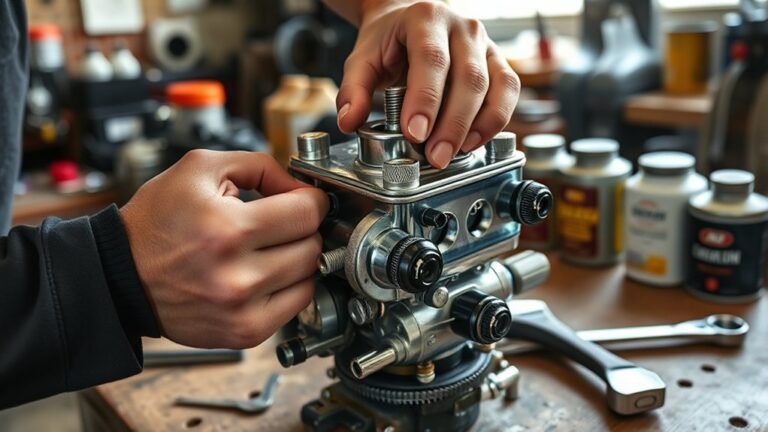
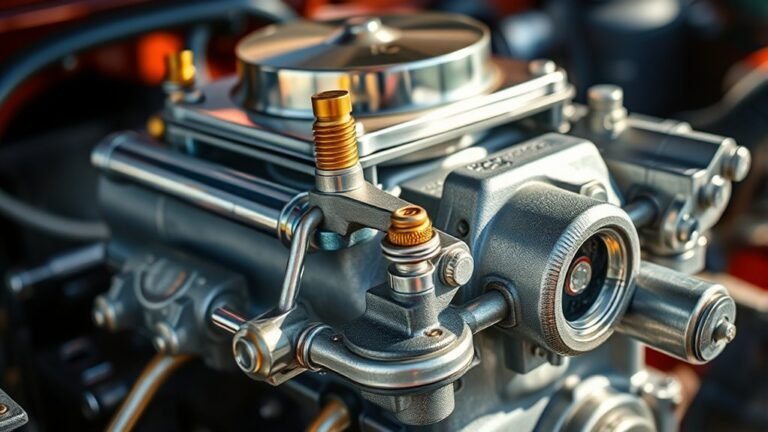
To adjust your Edelbrock carburetor, first warm up the engine and locate the idle speed and mixture screws. These are essential for fine-tuning the carburetor’s performance.
Use a tachometer to monitor RPM and turn the idle speed screw clockwise to raise or counterclockwise to lower RPM in small increments. Adjust the idle mixture screws carefully for optimal combustion and smooth idle.
Watch for engine hesitation or stalling as you make adjustments. Also, check the throttle linkage for smooth movement. Proper tuning ensures efficient performance; more detailed steps and troubleshooting can refine your results further.
How to Spot When Your Edelbrock Carburetor Needs Adjustment
How can you tell when your Edelbrock carburetor needs adjustment? Focus on engine performance indicators like rough idling, hesitation during acceleration, or black smoke from the exhaust. These symptoms often signify improper air-fuel mixture or idle speed, directly linked to carburetor settings.
Avoid distractions from irrelevant topics such as unrelated engine modifications or unused concepts like fuel injection tuning, which don’t apply here. Instead, rely on objective signs like poor throttle response or stalling, which pinpoint carburetor inefficiencies.
Monitoring these factors helps you decide when adjustment is necessary, ensuring optimal engine operation. Precise observation lets you address issues promptly, preventing damage or increased emissions. Recognizing these signs quickly is key to maintaining your Edelbrock carburetor’s performance without wasting time on irrelevant or unused information.
Tools and Prep for Edelbrock Carburetor Adjustment
Before adjusting your Edelbrock carburetor, gather essential tools like a flathead screwdriver, a tachometer, and a vacuum gauge. Make sure your workspace is clean, well-lit, and has good ventilation to ensure safety and accuracy.
Proper preparation will help you make precise adjustments without distractions or errors.
Essential Adjustment Tools
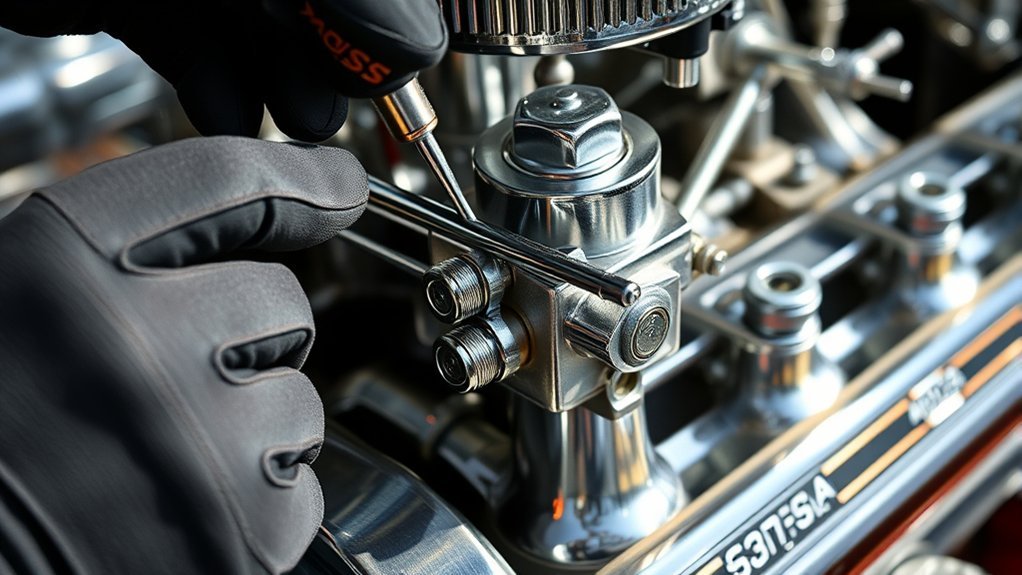
Several specialized tools are necessary to accurately adjust your Edelbrock carburetor and ensure optimal engine performance. You’ll need a flathead screwdriver for fine-tuning the idle mixture screws and an adjustable wrench to handle any throttle linkage adjustments.
A vacuum gauge is critical for monitoring manifold vacuum changes during tuning, providing real-time feedback. Avoid falling for carburetor myths suggesting fuel additives can replace proper mechanical adjustment; these additives won’t compensate for incorrect settings.
Additionally, a tachometer helps you maintain desired RPMs while adjusting, ensuring precision. A clean rag and small mirror assist in inspecting hard-to-see components.
Having these tools ready prevents guesswork, allowing you to focus on precise adjustments, ultimately stabilizing fuel-air mixture and idle quality.
Preparing Your Workspace
Having the right tools at hand sets the stage for an efficient Edelbrock carburetor adjustment, but preparing your workspace is just as important. Clear and organize your work area to minimize distractions and prevent contamination.
Use cleanup tips like wiping surfaces with a lint-free cloth and ensuring no debris interferes with carburetor components. Proper lighting and ventilation are essential for precision and safety.
Follow storage best practices by keeping tools and parts in labeled containers to avoid loss or mix-ups.
| Workspace Element | Preparation Tip |
|---|---|
| Surface | Clean, flat, and stable |
| Lighting | Bright, adjustable |
| Tool Storage | Sorted, labeled, accessible |
| Ventilation | Adequate airflow |
This setup ensures smooth, accurate adjustments with minimal risk of error.
Adjusting Idle Speed on an Edelbrock Carburetor
How do you guarantee your Edelbrock carburetor maintains a stable idle speed? Begin by warming the engine to operating temperature to ensure accurate adjustments. Locate the idle speed screw on the carburetor’s throttle lever.
Using a tachometer, slowly turn the idle speed screw clockwise to increase RPM or counterclockwise to decrease it. Adjust until the engine idle speed matches the manufacturer’s specified RPM range.
During carb maintenance, it’s crucial to make small incremental turns and allow the engine to stabilize between adjustments. Avoid over-adjusting, as excessive idle speed can cause engine wear and poor fuel economy.
After setting the idle speed, double-check for smooth engine operation and no stalling. This precise adjustment ensures your Edelbrock carburetor performs optimally during idle conditions.
Fine-Tuning the Edelbrock Carburetor’s Air-Fuel Mixture
To fine-tune your Edelbrock carburetor’s air-fuel mixture, start by locating the mixture screws, typically found near the base of the carburetor. You’ll adjust these screws to optimize idle mixture for smooth engine performance.
Afterward, test the air-fuel ratio using a gauge or exhaust analysis to ensure efficient combustion.
Identifying Mixture Screws
Where exactly are the mixture screws located on your Edelbrock carburetor? Typically, you’ll find them on the base of the carburetor, near the throttle body. These screws control the air-fuel ratio at idle, making them essential for tuning fundamentals.
Understanding carburetor basics, these screws are usually small, slotted, and may have a locknut or spring to prevent accidental movement. Identifying them correctly ensures precise adjustments later on.
On Edelbrock carburetors, there are generally two mixture screws, one for each primary barrel in a two-barrel carburetor setup. Their exact position can vary slightly by model, so consult your carburetor’s manual for specifics.
Recognizing these screws is crucial before you proceed with any fine-tuning to optimize engine performance and efficiency.
Adjusting Idle Mixture
Once you’ve located the mixture screws on your Edelbrock carburetor, adjusting the idle mixture becomes a straightforward process. Start the engine and let it warm to normal operating temperature. Slowly turn each idle mixture screw clockwise until the engine begins to stumble, then back it out counterclockwise until smooth operation resumes.
Your goal is to find the point where the idle mixture provides the highest, most stable idle speed without causing roughness or stalling. After setting the mixture screws, adjust the idle speed screw to reach the manufacturer’s recommended RPM.
Fine-tuning the idle mixture ensures optimal combustion efficiency during idle, improving both performance and fuel economy. Remember to make small, incremental adjustments and allow the engine to respond before proceeding.
Testing Air-Fuel Ratio
How can you accurately assess the air-fuel mixture to guarantee your Edelbrock carburetor runs at peak efficiency? Start by using a wideband oxygen sensor or an exhaust gas analyzer to measure the air-fuel ratio (AFR) directly. Avoid relying on irrelevant topics or random focus areas like general engine sounds; these won’t provide precise feedback.
Connect the sensor to your vehicle’s exhaust and monitor the AFR at idle and various RPMs. The ideal target is typically around 14.7:1 (stoichiometric) for balanced performance and emissions. Adjust the carburetor’s mixture screws incrementally, rechecking the AFR after each tweak.
This method ensures you’re fine-tuning based on accurate data, preventing guesswork. Precision here improves fuel economy, power delivery, and reduces emissions effectively.
Adjusting Throttle Linkage and Choke on Your Edelbrock Carburetor
Why is fine-tuning the throttle linkage and choke essential for your Edelbrock carburetor’s performance? Proper adjustment ensures smooth throttle response and optimal air-fuel mixture during startup and operation.
Begin by inspecting the throttle linkage for free movement without binding. Adjust the linkage so the throttle plates fully close at idle but open smoothly with pedal input.
Next, focus on choke adjustment. The choke plate must close completely when cold to enrich the mixture, then gradually open as the engine warms.
Use the choke linkage screws to set the initial choke position and the choke pull-off vacuum diaphragm to control choke opening rate.
Precise throttle linkage and choke adjustment prevents stalling, hesitation, and poor fuel economy, ensuring your Edelbrock carburetor performs reliably under all operating conditions.
Common Post-Adjustment Issues and How to Fix Them
What should you do if your Edelbrock carburetor doesn’t run smoothly after adjustments? Immediate idle troubleshooting is essential to restore carburetor efficiency. Start by checking these key areas:
- Fuel Mixture Imbalance: If the engine hesitates or stalls, fine-tune the idle mixture screws in small increments to achieve a stable idle.
- Vacuum Leaks: Inspect all gaskets and hoses for leaks that disrupt air-fuel ratio, reducing efficiency.
- Throttle Linkage Binding: Ensure the linkage moves freely; binding can cause inconsistent throttle response and rough idling.
Addressing these issues systematically will help you resolve post-adjustment problems effectively, guaranteeing your Edelbrock carburetor performs at its best without unnecessary downtime or guesswork.
Tips to Maintain Your Edelbrock Carburetor for Long-Lasting Performance
Regularly maintaining your Edelbrock carburetor is essential to guarantee consistent performance and prevent costly repairs. Focus on cleaning, inspecting, and adjusting components to extend its lifespan. Use two word discussion ideas like “fuel flow” and “air mixture” to guide your subtopic relevance during maintenance checks.
| Maintenance Task | Recommended Frequency |
|---|---|
| Clean Carburetor | Every 12 months |
| Inspect Gaskets | Every 6 months |
| Check Fuel Filter | Every 3 months |
| Adjust Idle Speed | As needed |
| Lubricate Linkages | Every 6 months |
Frequently Asked Questions
What Is the History of Edelbrock Carburetors?
Imagine tuning an old radio; the Edelbrock carburetor, rooted in the 1930s, revolutionized the history of carburetors by simplifying tuning basics.
It delivered precise fuel-air mixes, improving engine performance with practical, reliable adjustments.
Can Edelbrock Carburetors Be Used on Diesel Engines?
You can’t use Edelbrock carburetors on diesel engines, as diesels rely on fuel injection, not carburetion.
For improved engine performance, focus on proper diesel tuning tips like injector timing and fuel pressure adjustments instead.
How Do Edelbrock Carburetors Compare to Other Brands?
You’ll find Edelbrock carburetors offer engineered performance with reliable power delivery, though they can involve more tuning complexity than simpler brands. Their precise design suits enthusiasts wanting customizable, high-quality fuel management for optimal engine response.
What Fuel Types Are Compatible With Edelbrock Carburetors?
You can use regular gasoline, E85, or race fuels with Edelbrock carburetors, but be mindful of tuning quirks specific to each fuel type. Optimizing for fuel economics means adjusting jetting and mixture precisely for efficiency and performance.
Are Edelbrock Carburetors Legal for Street Use in All States?
You know what they say, “When in Rome, do as the Romans do.” Edelbrock carburetors’ street legality varies by state, depending on local emissions standards. You’ll need to verify compliance before using them on public roads.