How to Put Jeep in 4 Wheel Drive
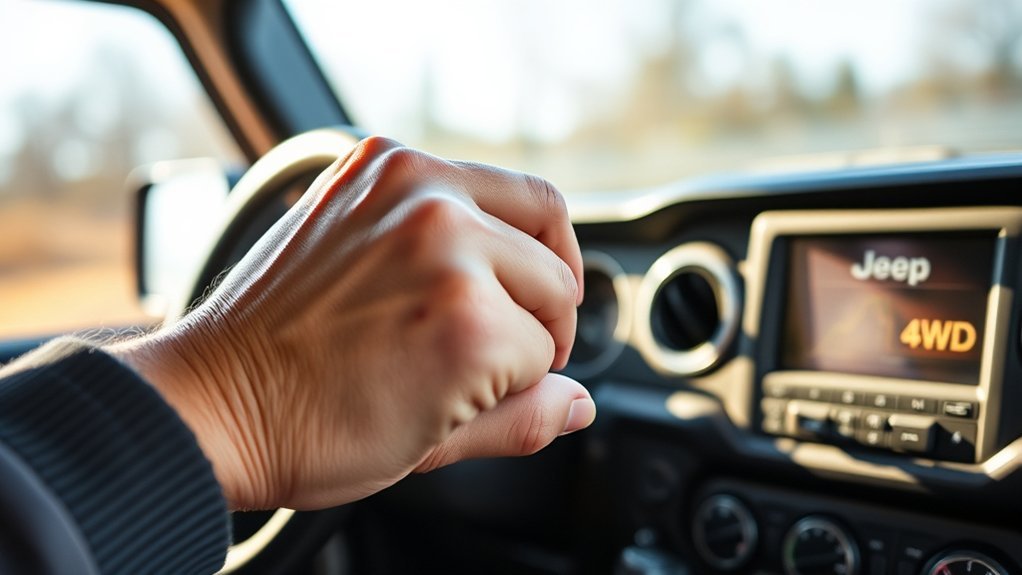
To put your Jeep in 4WD, first locate the lever, dial, or button marked 4WD or 4×4. This is the main control to engage four-wheel drive on your vehicle.
If your Jeep has a manual lever, pull it out and shift to 4H for high-range or 4L for low-range as needed. Newer models let you turn a dial or press a button to switch modes.
Remember to be in neutral or park when shifting to 4L. A light on the dash confirms 4WD is engaged.
Keep going to uncover tips and troubleshooting advice.
Key Takeaways
- Locate the 4WD control lever, dial, or button labeled 4WD or 4×4 inside your Jeep.
- For older models, pull the manual lever and shift into 4H or 4L as required.
- In newer Jeeps, turn the dial or press the button to select 4H or 4L modes.
- Ensure the vehicle is in neutral or park before shifting into 4L for safe engagement.
- Confirm 4WD activation by checking the 4WD indicator light on the dashboard.
When Should You Use 4WD on Your Jeep?
When should you use 4WD on your Jeep? You’ll want to engage 4WD when driving on slippery or uneven surfaces like snow, mud, sand, or loose gravel. It provides better traction by distributing power to all four wheels, helping you maintain control and avoid getting stuck.
Don’t use 4WD on dry pavement or smooth roads, as it can strain the drivetrain and reduce fuel efficiency. Instead, switch to 2WD for normal driving conditions.
Also, if you’re tackling steep hills or off-road trails, 4WD enhances stability and grip. Remember, using 4WD appropriately extends your Jeep’s lifespan and keeps you safe.
How to Put Your Jeep in 4WD (All Models)
Wondering how to engage 4WD on your Jeep? The process varies slightly by model, but generally, you’ll find a lever, dial, or button labeled 4WD or 4×4. For older Jeeps with a manual lever, simply pull the lever out and shift it into the desired 4WD mode, either 4H (high range) or 4L (low range), depending on your terrain.
For newer models, turn the dial or press the button to select 4H or 4L. Make sure your Jeep is in neutral or park when switching to 4L to avoid drivetrain damage. Once engaged, a 4WD indicator light will confirm activation.
Always consult your owner’s manual for model-specific steps to ensure smooth and safe 4WD engagement.
Troubleshooting Jeep 4WD Activation Issues
If your Jeep’s 4WD system isn’t engaging properly, you might face challenges on rough terrain or slippery roads. First, check if you’re following the correct procedure for your model. Some require you to stop before shifting, while others allow shifting on the fly.
Inspect the 4WD indicator light; if it doesn’t turn on, the issue could be an electrical fault or a blown fuse. Listen for the actuator motor’s sound when you switch to 4WD. Silence might mean a faulty actuator or a disconnected linkage.
Also, verify the transfer case fluid level, as low fluid can prevent proper engagement. If problems persist, consult a mechanic to avoid causing further damage to your Jeep’s drivetrain.
How to Keep Your Jeep’s 4WD Running Smoothly
To keep your Jeep’s 4WD running smoothly, you need to perform regular maintenance and pay attention to key components. Start by checking the transfer case fluid and changing it as recommended in your owner’s manual.
Regularly check and change your Jeep’s transfer case fluid to maintain smooth 4WD performance.
Inspect differential fluids and replace them when necessary to avoid wear and tear. Don’t forget to examine the drive shafts and U-joints for signs of damage or excessive play.
Regularly clean and lubricate the 4WD system components to prevent rust and ensure smooth engagement. Test your 4WD system occasionally on dry pavement to detect any unusual noises or difficulty shifting.
Staying on top of these tasks will help you avoid costly repairs and keep your Jeep’s 4WD reliable whenever you need it.
Frequently Asked Questions
Can I Use 4WD on Dry Pavement Without Damaging My Jeep?
You shouldn’t use 4WD on dry pavement because it can cause drivetrain binding and damage. Save it for slippery or off-road conditions where extra traction is necessary to protect your Jeep and ensure smooth handling.
What Is the Difference Between 4WD and AWD in Jeeps?
4WD sends power to all wheels evenly, great for off-roading and tough terrain, while AWD automatically adjusts power between wheels for better traction on slippery roads.
You’ll use 4WD for serious off-road challenges.
How Does 4WD Affect My Jeep’s Fuel Efficiency?
Engaging 4WD is like adding weight to your Jeep’s hustle; it demands more fuel, reducing efficiency. You’ll notice your miles per gallon drop since the engine works harder to power all wheels simultaneously.
Can I Switch Between 2WD and 4WD While Driving?
You can switch between 2WD and 4WD while driving, but only if your Jeep has part-time 4WD and you’re driving at low speeds.
Avoid shifting at high speeds to prevent drivetrain damage.
What Types of Terrain Are Best Suited for Jeep’s 4WD?
You’ll want to use your Jeep’s 4WD on rough terrains like mud, snow, sand, rocky trails, and steep hills. It gives you better traction and control, helping you tackle slippery or uneven surfaces safely.
Conclusion
Engaging your Jeep’s 4WD is like calling on a trusted co-pilot when the road gets tough. Whether you’re conquering muddy trails or snowy streets, knowing how to switch into 4WD keeps you in control and confident.
Just like a seasoned explorer relies on their map, you can rely on these steps to activate and maintain your Jeep’s 4WD system.
So, gear up and let your adventure begin—no terrain is too wild for you now when you know how to put Jeep in 4 wheel drive!