How to Measure Wheel Bolt Pattern
To measure your wheel bolt pattern, first count the number of lug holes on your wheel. This is the main step in identifying the bolt pattern accurately.
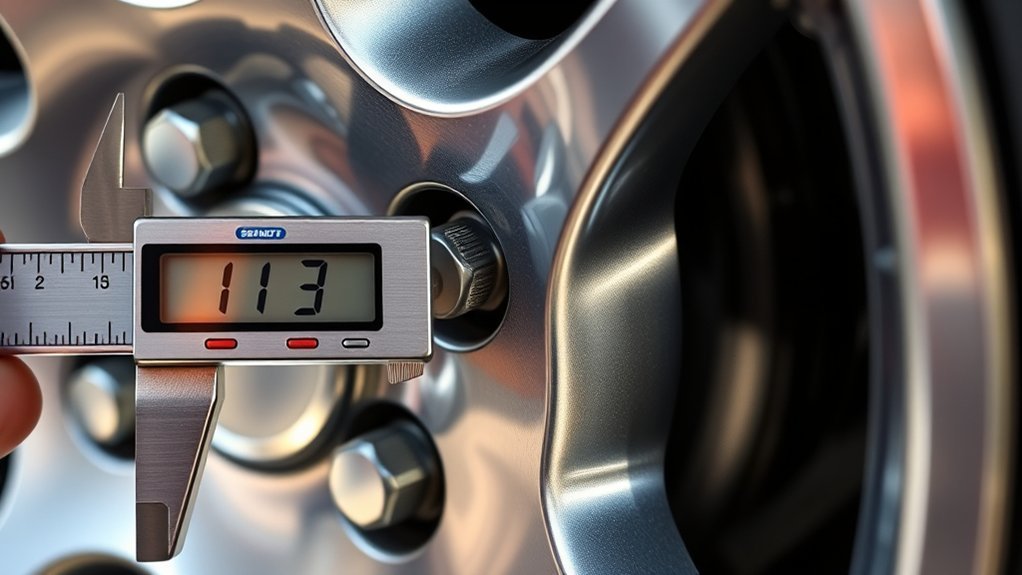
Next, use a ruler or caliper to measure the distance between the centers of specific lug holes. For wheels with an even number of lugs, measure directly across from one lug to the opposite lug. For wheels with an odd number of lugs, measure from the center of one lug hole to the outer edge of the lug hole directly across.
Record this measurement along with the lug count (for example, 5×114.3). Getting this right ensures a secure, vibration-free fit. Keep going to uncover tips that make choosing the perfect wheels easier.
Key Takeaways
- Identify the number of lug holes on the wheel before measuring the bolt pattern.
- For even lug counts, measure the distance center-to-center across opposite lug holes.
- For odd lug counts, measure from the center of one lug hole to the outer edge of the lug hole two positions away.
- Use a ruler, tape measure, or caliper for accurate measurement and record the lug count plus distance (e.g., 5×114.3).
- Avoid common mistakes by measuring center-to-center and verifying bolt pattern with wheel offset and size for proper fit.
Why Your Wheel Bolt Pattern Matters
Why does your wheel bolt pattern matter? It’s essential because it guarantees your wheels fit securely on your vehicle. If the bolt pattern doesn’t match, your wheels won’t mount properly, risking safety and performance.
You could face vibrations, uneven tire wear, or even wheel detachment while driving. Matching the bolt pattern also guarantees your wheels align correctly with your car’s hub, maintaining balance and handling.
Plus, it saves you time and money by preventing incompatible wheel purchases. Knowing your bolt pattern helps you choose wheels that complement your vehicle’s design and functionality.
Tools You Need to Measure Wheel Bolt Patterns
To measure your wheel bolt pattern accurately, you’ll need a few essential tools like a ruler or caliper. Having optional instruments like a tape measure or a bolt pattern gauge can make the process easier.
Let’s look at what tools will help you get the job done right.
Essential Measuring Tools
What tools do you need to accurately measure a wheel bolt pattern? First, grab a reliable ruler or tape measure with clear millimeter and inch markings. This helps you gauge the distance between bolt holes precisely.
You’ll also want a caliper, digital or manual, for more exact measurements, especially on smaller bolts. To avoid errors, use a straight edge or a piece of string to ensure you’re measuring directly between bolt centers, not edge to edge.
Finally, have a notepad or your phone handy to record measurements immediately. These essential tools ensure you get accurate bolt patterns without guesswork, setting the foundation for a perfect fit when selecting wheels or replacements.
Optional Helpful Instruments
Although basic tools cover most measuring needs, using optional helpful instruments can make measuring wheel bolt patterns easier and more precise. A digital caliper, for example, lets you measure bolt hole diameters and distances with remarkable accuracy, minimizing errors.
You might also find a bolt pattern gauge handy; it’s designed specifically to measure the distance between lug holes quickly. Additionally, a thread pitch gauge helps identify the thread size of the bolts, ensuring you get the right fit.
If you have access to a laser measuring tool, it can speed up the process by providing precise distance readings without physical contact. These instruments aren’t mandatory but can save you time and help avoid costly mistakes when determining wheel bolt patterns.
How to Measure Your Wheel Bolt Pattern Accurately
How exactly do you measure your wheel bolt pattern to ensure a perfect fit? Start by identifying the number of lug holes on your wheel. Then, use a ruler or caliper to measure the distance between the centers of two opposite lug holes.
For wheels with an even number of lug holes, measure directly across the circle from one hole center to the opposite hole center. If your wheel has an odd number of lugs, measure from the center of one lug hole to the outer edge of the lug hole directly across the circle.
Record this distance in millimeters or inches. This measurement, combined with the lug count, gives you the bolt pattern, often noted as “5×114.3” or similar, ensuring you pick the right wheels.
Measuring Bolt Patterns for Different Lug Counts
Now that you know how to measure your wheel bolt pattern, let’s look at how it varies with different lug counts.
You’ll measure 4 and 5 lug patterns differently than 6 and 8 lug patterns. Understanding these differences makes it easier to get accurate results every time.
Measuring 4 and 5 Lug
When measuring wheel bolt patterns for 4 and 5 lug wheels, you need to understand their specific layouts to get accurate results. For 4 lug wheels, simply measure the distance between two opposite bolts. For 5 lug wheels, measuring is a bit different since there isn’t a bolt directly opposite another.
Here’s how to do it:
- For 4 lug wheels, measure center-to-center across opposite bolts.
- For 5 lug wheels, pick any bolt and measure to the center of the bolt two positions away.
- Use a ruler or caliper for precise measurements.
- Record the number of lugs and the distance in millimeters or inches (e.g., 5×114.3).
These steps ensure you get the exact bolt pattern for your wheels.
Measuring 6 and 8 Lug
Wondering how to measure bolt patterns on 6 and 8 lug wheels? With these, you’ll measure from the center of one lug hole directly across to the center of the lug hole opposite it.
For 6 lug wheels, find the lug hole directly across from your starting point and measure straight through the center. For 8 lug wheels, do the same, measuring across the wheel through the centers of the opposite lug holes.
This method works because 6 and 8 lug patterns are even-numbered, making it straightforward to measure across from one lug to its opposite. Be sure to record the number of lugs along with the diameter in millimeters or inches to get the full bolt pattern, like 6×139.7 or 8×170.
Common Mistakes When Measuring Wheel Bolt Patterns
Why do so many people get wheel bolt pattern measurements wrong? It usually comes down to simple oversights that anyone can avoid. When measuring, you might:
- Measure from the center of one lug hole to the edge of the opposite hole, instead of center to center.
- Forget to account for odd-numbered lug patterns, which require a different measuring approach.
- Use a flexible tape measure instead of a rigid ruler, causing inaccurate readings.
- Assume all wheels with the same number of lugs share the same bolt pattern, leading to mismatches.
Tips for Choosing the Right Wheels Based on Bolt Pattern
Avoiding common measurement mistakes is just the first step; choosing wheels that match your bolt pattern ensures a secure fit and smooth performance. First, always double-check your bolt pattern measurement for accuracy. Next, consult your vehicle’s manual or manufacturer’s website for the exact specifications.
When shopping, filter wheels by your bolt pattern to narrow down suitable options quickly. Remember, even if a wheel looks good, it won’t fit properly without the right bolt pattern. Also, consider the wheel’s offset and size alongside the bolt pattern to maintain safe handling and avoid rubbing issues.
If you’re unsure, ask a professional or use online fitment guides. Following these tips helps you pick wheels that fit perfectly and keep your ride safe.
Frequently Asked Questions
Can Wheel Bolt Patterns Affect Vehicle Safety?
Yes, wheel bolt patterns affect your vehicle’s safety. If you don’t use the correct pattern, your wheels might not fit properly, causing instability or even wheel detachment while driving.
Always match the pattern exactly.
How Do Bolt Patterns Vary Between Car Brands?
You’ll find bolt patterns vary because each car brand designs them to fit specific wheel sizes and performance needs. Some prefer more bolts for strength, while others use fewer for lighter weight and style differences.
Are Wheel Spacers Compatible With Different Bolt Patterns?
You can’t just slap a medieval sword onto a Tesla. Wheel spacers must match your exact bolt pattern to fit properly. Using spacers with different patterns won’t align, causing safety issues and potential damage to your wheels.
Can I Change My Vehicle’s Bolt Pattern?
You can’t directly change your vehicle’s bolt pattern since it’s set by the hub. However, you can use adapters or swap hubs.
These methods might affect safety and handling, so proceed carefully and consult a professional.
Do Bolt Patterns Influence Tire Wear?
You’ll reduce uneven tire wear by ensuring the correct bolt pattern. Studies show improper fit can increase wear by 30%. When your wheels fit perfectly, your tires grip better and last much longer on the road.
Conclusion
Now that you know how to measure your wheel bolt pattern, you’re one step closer to finding the perfect wheels that fit like a glove. Don’t let a simple miscalculation turn into a headache bigger than a mountain.
With the right tools and careful measuring, you’ll avoid common mistakes and confidently choose wheels that match your ride flawlessly.
Remember, getting this right isn’t just important—it’s absolutely essential for your vehicle’s safety and style. Mastering how to measure wheel bolt pattern ensures your wheels fit perfectly every time.