When to Use 4 Wheel Drive
You should use 4-wheel drive when you’re tackling slippery, uneven, or rugged terrain like mud, snow, loose gravel, or steep hills where extra traction is essential. Engaging 4-wheel drive helps improve grip and vehicle control in these challenging conditions.
Activate it when your wheels spin or your vehicle struggles for traction. However, avoid using 4WD on dry pavement to prevent damage to the drivetrain.
It’s also handy when carrying heavy loads or towing on tough surfaces. If you want to maximize control and understand gear choices, there’s more to uncover.
Key Takeaways
- Use 4WD on slippery or loose surfaces like mud, snow, gravel, or rocky terrain for improved traction and control.
- Engage 4WD when climbing steep or slippery hills to prevent wheel spin and maintain stability.
- Switch to 4WD when towing heavy loads or hauling gear on uneven or rough terrain to avoid wheel slip.
- Avoid using 4WD on dry, paved roads to prevent drivetrain wear and reduce fuel efficiency.
- Disengage 4WD when conditions improve to save fuel and minimize mechanical strain.
What Is 4WD and How Is It Different From AWD?
What exactly sets 4WD apart from AWD? When you use 4WD, you engage all four wheels to receive equal power, which is especially helpful off-road or on slippery surfaces. It’s usually a system you activate manually, giving you control over when to use it.
AWD, on the other hand, works automatically, distributing power between front and rear wheels as needed without your input. AWD is great for everyday driving, offering improved traction on wet or icy roads.
But 4WD is built tougher, designed for rugged conditions like mud, snow, or rocky terrain. So, when you need maximum traction and control in challenging environments, 4WD is your go-to.
Understanding this difference helps you choose the right system for your driving needs.
How to Tell If Your Terrain Needs 4WD
How can you tell if your terrain demands 4WD? Look for surfaces where traction is limited, such as muddy trails, loose gravel, deep snow, or uneven rocky paths.
Limited traction on muddy, gravelly, snowy, or rocky terrain signals when 4WD is necessary for better control.
If your wheels spin easily or you feel your vehicle struggling to move forward, it’s a clear sign you need 4WD. Steep inclines or slippery hills also call for extra power distribution to all wheels.
If your vehicle feels unstable or you notice uneven tire grip, engaging 4WD can help maintain control. Avoid relying on 4WD on dry, paved roads since it isn’t necessary there and might cause wear.
Always assess the ground conditions and listen to your vehicle’s feedback; when traction is compromised, that’s when 4WD becomes essential.
When Should You Use 4WD for Best Traction?
You should use 4WD when you’re traversing off-road terrain, slippery roads, or carrying heavy loads. These conditions demand extra traction to keep you safe and in control.
Knowing when to engage 4WD can make all the difference in your driving experience.
Off-Road Terrain Conditions
When should you engage 4WD to tackle off-road terrain effectively? You should switch to 4WD when driving over rugged surfaces where extra traction is essential.
Uneven ground, loose soil, and rocky paths can cause your wheels to slip. Using 4WD distributes power evenly to all wheels, helping you maintain control and avoid getting stuck.
Here’s a quick guide to when 4WD is your best bet:
| Terrain Type | When to Use 4WD |
|---|---|
| Rocky trails | Always, for better grip |
| Muddy paths | Use 4WD to prevent slipping |
| Sand dunes | Engage 4WD for steady drive |
| Gravel roads | Use 4WD if loose and deep |
| Steep inclines | 4WD helps maintain traction |
This setup ensures you navigate off-road challenges safely and confidently.
Slippery Road Surfaces
Off-road terrain demands 4WD for better grip, but slippery road surfaces also call for extra traction to keep you safe. When rain, ice, snow, or mud coat the roads, your regular 2WD might struggle to maintain control.
Engaging 4WD distributes power evenly to all wheels, reducing wheel spin and improving stability. You should switch to 4WD as soon as you notice your tires slipping or struggling for traction.
However, avoid using 4WD on dry pavement, as it can cause drivetrain binding and unnecessary wear. Remember, 4WD boosts your grip but doesn’t replace cautious driving.
Slow down, keep a safe distance, and use 4WD to help you maintain control when the road gets slick or unpredictable.
Heavy Load Situations
How do you guarantee your vehicle maintains traction under heavy loads? Using 4WD in heavy load situations can make a big difference. When your truck or SUV is towing a trailer or hauling a heavy payload, the extra grip from all four wheels engaging helps prevent wheel slip and loss of control.
This is especially important on uneven or loose surfaces where traction can be compromised.
Consider switching to 4WD when:
- You’re towing uphill or on rough terrain
- Carrying heavy gear over gravel or dirt roads
- Navigating slippery or muddy driveways with a full load
Using 4WD Safely on Snow and Ice
When driving with 4WD on snow and ice, you’ll want to keep traction control in check to avoid skidding.
Slow down and increase your following distance to give yourself more reaction time. These adjustments help you stay safe while making the most of your 4WD system.
Maintaining Traction Control
Why does maintaining traction control matter most on snowy and icy roads? Because it helps you keep your vehicle stable and prevents wheel spin, which can lead to dangerous skids.
When you engage 4WD, traction control works with it to manage power distribution, ensuring your tires grip the slippery surface effectively.
To maintain traction control safely, remember to:
- Avoid sudden acceleration or braking that can cause wheels to slip
- Steer smoothly and gently to prevent losing grip
- Use traction control features as intended, without overriding them
Adjusting Speed and Distance
Slow down and increase your following distance to give yourself more time to react on snowy and icy roads. Even with 4WD engaged, your vehicle’s stopping distance increases significantly. Don’t rely solely on 4WD to maintain control; adjust your speed to match road conditions.
Drive smoothly. Avoid sudden accelerations, sharp turns, or hard braking, which can cause loss of control. Maintain at least double the normal following distance to account for reduced traction and longer stopping distances.
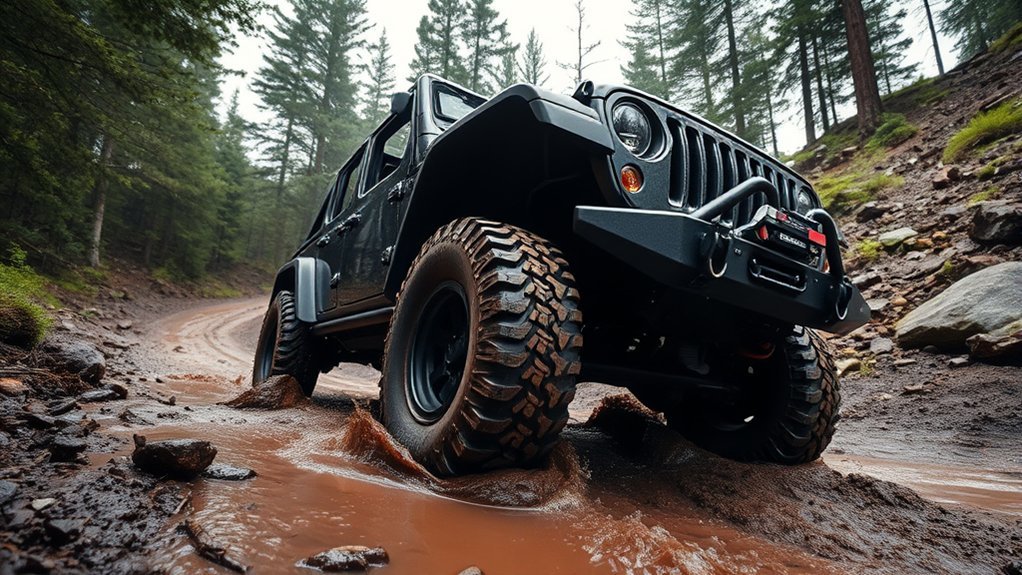
Why 4WD Helps on Muddy and Slippery Trails
How does 4WD make a difference on muddy and slippery trails? When you engage 4WD, power goes to all four wheels instead of just two, giving you better traction. This helps you maintain control and avoid getting stuck in tricky spots.
You’ll notice your vehicle grips the surface more effectively, letting you navigate through slippery conditions with greater confidence.
Here’s why 4WD helps on muddy and slippery trails:
Improved Traction: Distributes power evenly to prevent wheel spin.
Enhanced Stability: Keeps your vehicle balanced on uneven, slick terrain.
Better Control: Allows smoother acceleration and braking, reducing slip risks.
Using 4WD in these conditions boosts your safety and off-road capability.
When Not to Use 4WD to Avoid Damage
Using 4WD when it’s not needed can cause unnecessary wear and even damage to your vehicle. Avoid engaging 4WD on dry, paved roads because it puts extra strain on the drivetrain, leading to accelerated wear of components like the transfer case and differential.
You also risk binding the tires, which can cause handling issues and uneven tire wear. Don’t use 4WD in tight turns or during high-speed driving, as the system isn’t designed for these conditions and may suffer mechanical stress.
If your vehicle has a part-time 4WD system, keep it disengaged unless you’re on slippery, loose, or uneven surfaces. By only using 4WD when necessary, you’ll protect your vehicle’s longevity and avoid costly repairs down the road.
How 4WD Affects Your Vehicle’s Fuel Economy
Using 4WD can lower your vehicle’s fuel economy because it adds extra weight and increases drivetrain resistance. You’ll notice your mileage drops when 4WD is engaged, especially on dry pavement.
To save fuel, switch back to 2WD whenever you don’t need the added traction.
Impact On Mileage
Four-wheel drive systems often decrease your vehicle’s fuel efficiency because they add extra weight and increase drivetrain resistance. When you engage 4WD, power is sent to all four wheels instead of just two, which means your engine works harder and burns more fuel. This impact on mileage can be noticeable, especially during extended use on dry pavement or in conditions where 4WD isn’t necessary.
Keep these points in mind about how 4WD affects your fuel economy:
- Extra drivetrain components add weight, reducing miles per gallon.
- Increased mechanical drag from powering all four wheels consumes more fuel.
- Using 4WD on dry or smooth roads wastes energy without traction benefits.
Understanding this impact helps you decide when to engage 4WD without hurting your vehicle’s fuel efficiency.
Fuel Efficiency Tips
How can you maintain better fuel efficiency while relying on 4WD? First, only engage 4WD when necessary, like on slippery or uneven terrain. Driving in 4WD on dry, smooth roads wastes fuel since it adds extra drivetrain drag.
Shift back to 2WD as soon as conditions allow. Keep your tires properly inflated; underinflated tires increase rolling resistance and lower mileage. Regularly maintain your vehicle, including engine tune-ups and air filter changes, to keep it running efficiently.
Avoid aggressive acceleration and excessive idling, which both increase fuel consumption. Lastly, reduce unnecessary weight and remove roof racks when not in use to minimize drag.
Choosing Between High and Low 4WD Gears
When should you switch between high and low 4WD gears? Use high 4WD for moderate off-road conditions like dirt roads or snowy highways, where you need extra traction without sacrificing speed. Low 4WD is best for tough situations requiring maximum power and control, such as steep hills, deep mud, or rocky terrain.
Here’s when to choose low 4WD:
- Navigating steep inclines or declines
- Crawling over rocks or deep ruts
- Pulling heavy loads at low speeds
High 4WD is ideal when you want better traction but still maintain higher speeds. Remember, low 4WD increases torque but limits speed, so use it only when necessary to avoid damaging your drivetrain or losing control.
How to Engage and Disengage 4WD Correctly
Wondering how to properly engage and disengage 4WD to get the best performance? First, ensure your vehicle is either stopped or moving slowly, usually under 5 mph, before shifting into 4WD.
To engage 4WD properly, stop or move very slowly—typically under 5 mph—before shifting gears.
For many vehicles, shifting into 4WD high can be done while rolling gently, but always check your owner’s manual. To engage 4WD low, stop completely, shift to neutral, then select 4WD low.
This prevents damage to the transfer case and drivetrain. When you’re done with 4WD, reverse the process: shift back to 2WD or 4WD high (depending on your vehicle) while stationary or moving slowly, then accelerate gently.
Following these steps helps your system engage smoothly and avoids unnecessary wear or mechanical issues.
Common 4WD Mistakes and How to Avoid Them
Although 4WD systems are designed to improve traction and control, many drivers make common mistakes that can damage their vehicle or reduce performance. Avoid these pitfalls to get the most out of your 4WD:
- Using 4WD on dry pavement: This causes drivetrain binding, leading to costly repairs.
- Leaving 4WD engaged unnecessarily: It increases fuel consumption and wears out components faster.
- Ignoring maintenance: Failing to check fluids and inspect parts can cause system failure when you need it most.
Frequently Asked Questions
Can 4WD Be Used on Paved Roads Without Causing Damage?
You shouldn’t use 4WD on paved roads because it can cause drivetrain binding and damage.
Save it for slippery or off-road conditions where extra traction is necessary to protect your vehicle’s components and ensure proper performance.
How Does 4WD Impact Vehicle Maintenance Costs?
You’ll likely face higher maintenance costs with 4WD because it adds complexity, increasing wear on components like differentials and transfer cases.
Regular servicing is vital to avoid expensive repairs and keep everything running smoothly.
Are There Specific Tire Types Recommended for 4WD Vehicles?
Imagine gripping muddy trails tightly. You’ll want all-terrain or mud-terrain tires for your 4WD. They provide the traction and durability needed to conquer rough surfaces and keep your ride steady and safe.
Can 4WD Improve Towing Capacity and Stability?
Yes, 4WD can improve towing capacity and stability by distributing power to all wheels, giving you better traction and control on uneven or slippery surfaces. This helps you tow safely, especially off-road or in tough conditions.
What Are the Differences Between Part-Time and Full-Time 4WD Systems?
You’ll find part-time 4WD lets you switch between two and four wheels, saving fuel, while full-time 4WD powers all wheels constantly for better traction.
Full-time suits varied conditions; part-time is best off-road.
Conclusion
When you use 4WD correctly, you’ll greatly improve your vehicle’s traction and safety on tough terrain. Did you know that 4WD can reduce the risk of getting stuck by up to 50% on slippery trails?
Just remember to switch it off when you’re on dry pavement to save fuel and avoid damage.
By understanding when and how to engage 4WD, you’ll tackle snow, mud, and uneven ground with confidence and control every time. Knowing when to use 4 wheel drive is key to maximizing your vehicle’s performance and safety.