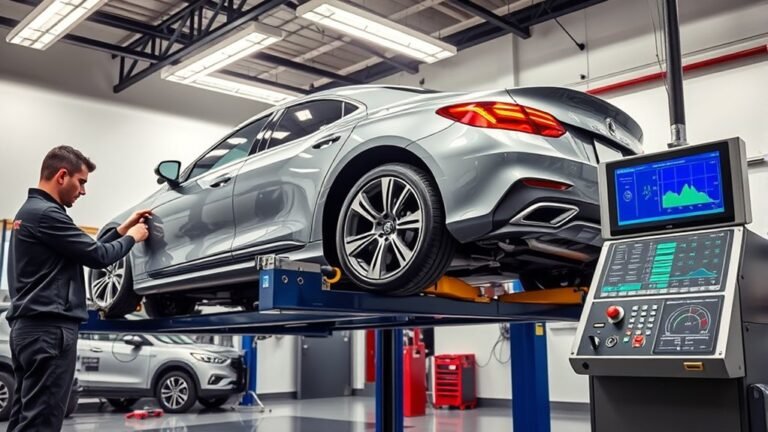
How Long Do Shocks Last
You can expect your vehicle’s shocks to last between 50,000 and 100,000 miles, depending on driving habits and road conditions. How long do shocks last varies based on factors like the quality of the shocks and the terrain you frequently drive on.
Harsh roads, potholes, and aggressive driving wear shocks faster, while regular maintenance and inspections help maximize their lifespan.
Signs like excessive bouncing or oil leaks indicate worn shocks needing replacement to maintain safety and ride comfort. Understanding these factors can help you protect your shocks and guarantee your vehicle performs at its best over time.
Keeping an eye on these symptoms ensures timely repairs and a smoother driving experience.
Key Takeaways
- Shocks typically last between 50,000 and 100,000 miles under normal driving conditions.
- Harsh roads and aggressive driving can significantly reduce shock lifespan.
- Premium shocks like monotube or gas-charged models resist wear better and last longer.
- Regular maintenance, including inspections every 12,000 miles, helps maximize shock durability.
- Signs of worn shocks include excessive bouncing, nose-diving, uneven tire wear, and oil leaks.
How Long Do Shocks Usually Last?
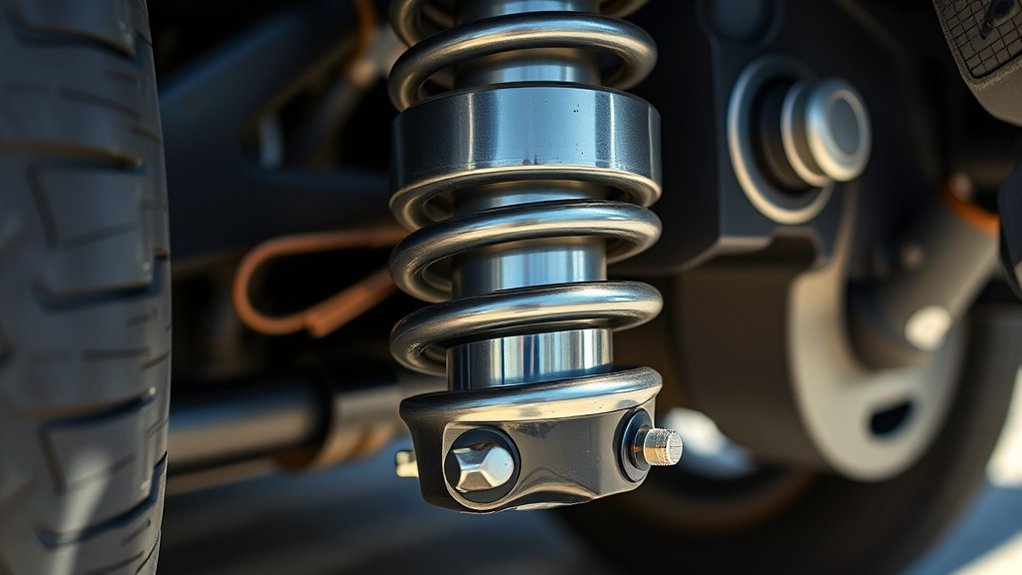
How long do shocks usually last depends on several factors, including the type of shock absorber, driving conditions, and maintenance habits. Typically, shocks last between 50,000 and 100,000 miles, but harsh road conditions or aggressive driving can reduce their lifespan significantly.
If you ignore worn shocks, you risk irreversible damage to suspension components, which can be costly to repair. Additionally, degraded shocks affect your vehicle’s stability and handling, leading to uneven tire wear and decreased fuel economy.
Regular inspections and timely replacements ensure optimal performance and prevent further mechanical issues. By maintaining your shocks properly, you keep your ride smooth and your vehicle operating efficiently, saving you money on fuel and avoiding expensive repairs linked to suspension failure.
How Can You Tell If Your Shocks Are Worn?
Neglecting worn shocks can compromise your vehicle’s safety and lead to costly repairs, so identifying signs of wear early is important. You can tell if your shocks are worn by observing handling issues like excessive bouncing, nose-diving during braking, or uneven tire wear, all of which indicate degraded damping performance.
Early detection of worn shocks prevents safety risks and costly vehicle repairs.
Inspect for oil leaks around the shock body, as this fluid loss violates safety standards requiring effective suspension control. Reduced shock efficiency also negatively impacts fuel economy by increasing rolling resistance and vehicle instability.
Additionally, listen for unusual noises such as clunking or rattling over bumps, which suggest internal wear. A professional suspension inspection can measure shock absorber responsiveness to ensure compliance with safety standards.
Monitoring these indicators helps maintain vehicle control and optimizes fuel economy.
What Driving Habits Wear Out Shocks Faster?
You wear out shocks faster when you brake hard frequently, as it puts extra stress on the suspension system. Driving on rough terrain causes continuous impacts that accelerate shock absorber degradation.
Also, hitting bumps at excessive speeds forces shocks to work beyond their designed limits, reducing their lifespan considerably.
Frequent Hard Braking
Why does frequent hard braking accelerate shock absorber wear? When you brake hard repeatedly, your shocks endure rapid compression and extension cycles, increasing internal fluid turbulence and heat. This intensifies the breakdown of seals and damping fluid, accelerating shock wear.
Frequent braking causes your shocks to work overtime, losing their ability to absorb and dissipate energy effectively. As a result, the shocks’ structural components face higher stress levels, leading to premature fatigue and failure.
Over time, this reduces ride comfort, handling stability, and overall safety. To minimize shock wear, avoid abrupt stops and maintain smooth deceleration.
Rough Terrain Driving
How does driving on rough terrain accelerate shock absorber wear? When you navigate uneven surfaces, your shocks endure constant, intense compression and rebound cycles. This repetitive stress forces the internal components, like valves and seals, to work harder, accelerating wear.
Uneven terrain also increases the likelihood of impacts that can damage shock integrity, leading to premature failure. To mitigate this, prioritize regular shock maintenance by inspecting for leaks, unusual noises, and diminished damping performance.
Maintaining proper tire pressure and suspension alignment also helps distribute forces evenly. Remember, rough terrain driving demands more frequent shock maintenance because the shocks absorb more energy, shortening their lifespan. By adapting your maintenance schedule to your driving environment, you can extend shock life and maintain optimal vehicle handling on challenging surfaces.
Excessive Speed Over Bumps
When driving over bumps, what impact does excessive speed have on your vehicle’s shocks? Excessive speed dramatically increases the force exerted on shocks when you hit bumps and potholes, causing rapid wear and potential failure.
Your shocks absorb more violent impacts, reducing their lifespan significantly. Slow down to extend shock durability and maintain ride quality.
| Driving Habit | Effect on Shocks |
|---|---|
| Excessive speed | Accelerates shock wear |
| Hitting bumps fast | Increases shock strain |
| Ignoring potholes | Causes premature failure |
| Smooth, slow driving | Prolongs shock lifespan |
How Do Road Conditions Affect Shock Life?
Road conditions play a crucial role in determining the lifespan of your vehicle’s shocks. When you drive on a smooth road surface with high-quality asphalt, your shocks undergo less stress, preserving their damping efficiency and structural integrity.
Conversely, rough or uneven surfaces, potholes, and degraded asphalt quality cause repetitive, intense impacts that accelerate shock wear. These harsh conditions increase the frequency and magnitude of force shocks must absorb, leading to faster oil leakage, seal deterioration, and internal component fatigue.
Maintaining your shocks requires paying close attention to the roads you frequently travel. If you often encounter poor road surfaces, expect a shorter shock life and plan for more frequent inspections and replacements to ensure optimal vehicle handling and safety.
Which Types of Shocks Last the Longest?
Which shock absorbers last the longest depends largely on their design and construction materials. Generally, monotube shocks outperform twin-tube models in durability due to their robust aluminum bodies and superior heat dissipation.
Gas-charged shocks also resist fading better under repeated tire impact, extending their functional lifespan. You’ll find that shocks with high-grade seals and piston rods reduce wear, minimizing the need for frequent shock maintenance.
Additionally, shocks designed with enhanced valving systems better absorb irregular tire impacts, preserving internal components. While budget shocks may seem cost-effective, investing in premium materials and advanced engineering pays off in longevity.
Ultimately, selecting shocks built to withstand harsh conditions and heavy tire impact ensures fewer replacements and more consistent vehicle control over time.
How to Check Your Shocks for Wear at Home
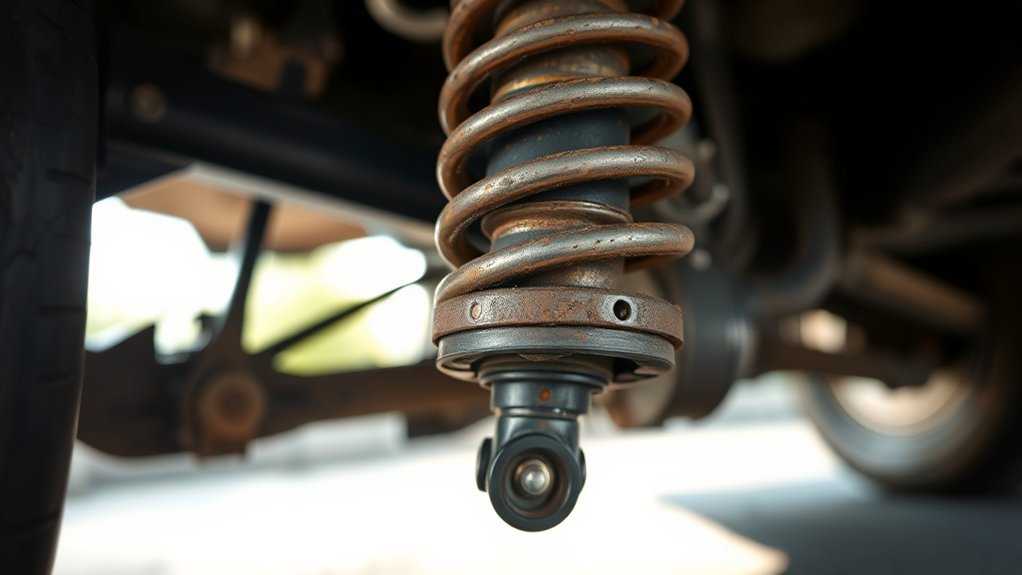
You can start by visually inspecting your shocks for leaks, dents, or corrosion that indicate wear. Next, perform the bounce test by pressing down on each corner of your vehicle and observing how it responds. Excessive bouncing signals worn shocks.
Finally, check your tires for uneven wear patterns, which often result from failing shock absorbers.
Visual Inspection Tips
How can you quickly determine if your shocks are wearing out without specialized tools? Start with a thorough visual inspection to catch early signs of wear that affect ride quality and safety.
- Check for Leaks: Inspect the shock body for oil leaks or wetness, which indicate seal failure. Leaking shocks can compromise handling regardless of tire pressure.
- Examine Mounts and Bushings: Look for cracked or worn rubber bushings at mounting points. Damaged mounts can cause noise and uneven wear, especially if your vehicle has roof racks that add stress.
- Inspect Shock Condition: Look for dents, corrosion, or bent components. Any visible damage reduces shock efficiency and should prompt replacement.
Regular inspections will help you maintain optimal suspension performance and avoid unexpected failures.
Bounce Test Method
Wondering whether your shocks are still performing at their best without needing professional equipment? The bounce test method is a straightforward way to evaluate shocks durability at home.
Push down firmly on one corner of your vehicle and release. If the vehicle bounces more than once or twice, your shocks may be worn out. This simple testing method helps you quickly identify diminished damping ability, a key factor in shocks durability.
| Step | What to Observe |
|---|---|
| 1. Push down | Apply firm pressure on a corner |
| 2. Release | Let go quickly |
| 3. Count bounces | Note how many times it bounces |
| 4. Interpretation | >2 bounces means wear likely |
| 5. Repeat | Check all corners for consistency |
This method offers an efficient preliminary test of shock performance.
Uneven Tire Wear Signs
Where should you look if you suspect worn shocks beyond the bounce test? Uneven tire wear is a key indicator. When shocks degrade, they fail to keep tires firmly on the road, causing irregular tread wear patterns.
To check for wear at home, focus on these areas:
- Inspect tire tread for irregular or patchy wear, especially cupping or scalloping.
- Listen for suspension squeaks or creaks during slow turns or over bumps, signaling worn shock mounts or bushings.
- Examine the shocks for oil leaks or physical damage, which compromise damping performance.
Spotting these signs early helps you avoid compromised handling and premature tire replacement. Regularly monitoring uneven tire wear and suspension squeaks ensures your shocks function optimALLY, maintaining vehicle safety and ride quality.
When Should You Replace Shocks for Safety and Comfort?
When do you need to replace your shocks to maintain optimal safety and comfort? You should consider shocks testing if you notice diminished ride smoothness or increased vehicle body roll. Shocks wear out progressively, reducing their ability to absorb road impacts effectively.
Perform shocks testing regularly, especially after 50,000 miles or if you experience unstable handling, excessive bouncing, or longer braking distances. During testing, mechanics evaluate the shock absorbers’ resistance and fluid integrity to ensure proper damping performance.
Replacing shocks promptly restores ride smoothness, improves tire contact with the road, and enhances vehicle stability. By acting on these indicators, you maintain both safety and comfort, preventing further suspension damage and ensuring reliable control in various driving conditions.
What Happens If You Delay Replacing Worn Shocks?
Neglecting to replace worn shocks can lead to a cascade of problems affecting your vehicle’s performance and safety. Ignoring this issue isn’t an unrelated topic or random speculation; it directly impacts critical systems. Here’s what happens if you delay:
- Compromised Handling: Worn shocks reduce tire contact with the road, impairing steering precision and increasing stopping distances.
- Increased Wear: Suspension components and tires experience accelerated wear due to uncontrolled oscillations and vibrations.
- Safety Risks: The vehicle becomes more prone to instability during emergency maneuvers, heightening rollover and collision risks.
Delaying shock replacement doesn’t just degrade comfort. It undermines your vehicle’s structural integrity and safety systems, leading to costly repairs and dangerous driving conditions. Addressing shocks promptly is essential to maintain optimal vehicle control and safety.
How to Extend the Lifespan of Your Shocks
How can you maximize the durability of your shocks to avoid premature failure? Regular shock maintenance is essential. Begin by inspecting your shocks for leaks, dents, or worn bushings every 12,000 miles or as recommended by your vehicle manufacturer.
Maximize shock durability by regularly inspecting for leaks, dents, or worn bushings every 12,000 miles.
Keep your tires properly inflated and aligned to reduce uneven stress on the shocks. Avoid aggressive driving over rough terrain, which accelerates wear. Clean shocks regularly to prevent dirt buildup that can degrade seals and components.
Additionally, replace suspension components, such as springs and mounts, when worn to maintain optimal ride quality. By following these steps, you ensure your shocks perform efficiently, extending their lifespan while preserving consistent ride quality and vehicle stability.
Consistent maintenance reduces costly repairs and improves overall safety on the road.
Frequently Asked Questions
Can Different Vehicle Models Affect Shock Absorber Lifespan?
Yes, different vehicle models affect shock absorber lifespan because manufacturers conduct model testing to optimize shock design for specific ride comfort.
Your shocks wear uniquely based on suspension setup, weight, and intended driving conditions.
Are There Specific Brands Known for More Durable Shocks?
Coincidentally, brands like Bilstein, KYB, and Monroe lead durability comparisons in shock brands. You’ll find their advanced materials and engineering deliver consistent performance, ensuring longer-lasting shocks that handle varied driving conditions with precision and reliability.
How Do Shocks Impact Fuel Efficiency?
You’ll notice poor shock longevity can decrease fuel economy since worn shocks cause your vehicle to work harder, increasing rolling resistance and uneven tire wear. This ultimately reduces fuel efficiency and raises overall fuel consumption during driving.
Can Worn Shocks Cause Uneven Tire Wear?
Yes, worn shocks can cause uneven tire wear by failing to maintain proper tire contact with the road. This results in inconsistent pressure distribution, accelerating tire tread degradation and reducing overall vehicle handling and safety.
Is It Necessary to Replace Shocks in Pairs?
Yes, you should replace shocks in pairs to ensure balanced performance and even shocks lifespan. Replacement pairing maintains vehicle stability, prevents uneven wear, and optimizes suspension efficiency.
This approach provides a safer and smoother driving experience.
Conclusion
You might not notice it at first, but worn shocks quietly diminish your ride’s smoothness and safety. By paying attention to signs and maintaining good driving habits, you can gently extend their lifespan.
Don’t let time’s subtle wear catch you off guard—replacing shocks on schedule preserves comfort and control. Taking these steps guarantees your vehicle remains reliable, protecting both you and your passengers from the hidden toll of aging components.
Understanding how long do shocks last and when to replace them is key to maintaining optimal performance and safety on the road.