Is All Wheel Drive the Same as 4 Wheel Drive
All-wheel drive (AWD) and four-wheel drive (4WD) aren’t the same—you serve different purposes. Understanding the difference between all wheel drive and 4 wheel drive is important for choosing the right vehicle for your needs.
AWD automatically sends power to all wheels for everyday traction on wet or light off-road surfaces, while 4WD requires you to engage it manually and is built for tougher terrains like deep mud or steep hills.
AWD suits daily driving with better fuel efficiency, and 4WD is great for rugged off-road use. Keep exploring to understand which system fits your driving style best.
Key Takeaways
- AWD automatically distributes power to all wheels full-time, while 4WD requires manual engagement to activate four-wheel power.
- AWD uses a center differential or electronic clutch for seamless torque adjustment; 4WD relies on a transfer case and often low-range gearing.
- AWD is designed for on-road conditions like rain and light snow; 4WD excels in rugged off-road and extreme terrain situations.
- AWD is common in sedans and crossovers for everyday driving; 4WD is typical in trucks and large SUVs for off-roading and towing.
- AWD consumes less fuel due to continuous, automatic operation; 4WD should be engaged only when needed to conserve fuel.
What Is All-Wheel Drive (AWD) and How It Works
How does all-wheel drive (AWD) actually work? AWD automatically distributes power to all four wheels, adjusting as needed to maintain traction. Unlike systems you have to engage manually, AWD operates seamlessly in the background.
Sensors monitor wheel slip, and the system shifts torque between the front and rear axles to keep you stable on wet, icy, or uneven surfaces. You don’t have to think about it—it’s always active, providing better grip during everyday driving and light off-road conditions.
AWD is perfect if you want improved handling and safety without extra effort. Just drive normally, and the system handles traction control for you, helping you stay confident whether you’re cruising city streets or tackling a rainy highway.
What Is Four-Wheel Drive (4WD) and How It Works
While all-wheel drive (AWD) quietly manages traction for everyday driving, four-wheel drive (4WD) gives you more control when the terrain gets tough. 4WD lets you manually engage power to all four wheels, making it ideal for off-road adventures or harsh conditions where maximum traction is a must.
When activated, 4WD distributes engine power evenly to both front and rear axles, helping you maintain grip on slippery or uneven surfaces like mud, snow, or rocky trails. You typically switch 4WD on using a lever or button, depending on your vehicle.
Many 4WD systems also include a low-range gear, providing extra torque for climbing steep hills or navigating challenging terrain. This setup gives you the confidence to tackle demanding driving situations without losing control.
What Are the Key Differences Between AWD and 4WD?
You’ll notice that AWD and 4WD use different drivetrain setups to handle power distribution. Each system performs better on certain terrains, so knowing where you’ll drive matters.
Plus, the type of vehicle you have often determines which system is best suited for your needs.
Drivetrain Mechanism Differences
What sets all-wheel drive (AWD) apart from four-wheel drive (4WD) lies mainly in their drivetrain mechanisms. AWD systems use a center differential or an electronic clutch to distribute power automatically between the front and rear wheels. This setup constantly adjusts torque, giving you seamless traction without any input.
On the other hand, 4WD typically relies on a transfer case that you manually engage to send power to all four wheels. It often includes low-range gearing for extra torque in tough conditions. While AWD runs full-time and handles power distribution on the fly, 4WD is usually part-time and designed for off-road or heavy-duty use.
Understanding these drivetrain differences helps you pick the right system for your driving needs.
Terrain Adaptability Comparison
The way AWD and 4WD handle different terrains reflects their drivetrain designs. AWD automatically distributes power to all wheels, adapting seamlessly to wet roads, light snow, and gravel.
4WD, however, requires manual engagement and excels on rugged, off-road trails, deep mud, or heavy snow by providing maximum traction.
| Terrain Type | AWD Performance | 4WD Performance |
|---|---|---|
| Wet Roads | Smooth, automatic power shift | Effective but manual control |
| Light Snow | Reliable traction, no input | Good, but engagement needed |
| Off-Road Trails | Limited, may slip | Superior, designed for tough use |
| Deep Mud/Snow | Struggles, less torque control | Excellent, maximizes grip |
You’ll want AWD for everyday versatility and 4WD for extreme terrain challenges.
Typical Vehicle Applications
Where do AWD and 4WD systems typically show up on the road? You’ll find them in very different vehicles, designed for specific needs. AWD is common in cars and crossovers that you drive daily, offering better traction on wet or snowy roads. On the other hand, 4WD is built for tough off-road conditions and heavy-duty tasks.
Here’s where you’ll see each system:
- AWD: Sedans, crossovers, and some SUVs for improved all-weather handling.
- 4WD: Trucks and large SUVs for off-roading and towing.
- AWD: Urban and suburban use where road conditions vary frequently.
- 4WD: Rural or rugged environments requiring maximum traction and durability.
Knowing this helps you pick the right vehicle for your driving style.
When Should You Use AWD vs. 4WD?
When do you need AWD instead of 4WD? Choose AWD if you drive mostly on paved roads but want extra traction in rain, light snow, or mild off-road conditions. AWD automatically adjusts power to each wheel, so you don’t have to think about it.
Choose AWD for paved roads with rain, light snow, or mild off-road—automatic power adjustment keeps you safe.
It’s perfect for everyday driving, especially if weather changes unexpectedly.
On the other hand, use 4WD when you plan to tackle rough terrain, deep snow, mud, or steep hills. 4WD gives you more control and power in extreme off-road situations but usually requires manual engagement.
If you frequently go off-road or face challenging conditions, 4WD is the better choice. Otherwise, AWD offers a hassle-free way to stay safe and confident on slippery roads.
How AWD and 4WD Affect Performance and Fuel Efficiency
How do AWD and 4WD impact your vehicle’s performance and fuel efficiency? Both systems improve traction but affect your ride differently. AWD constantly distributes power to all wheels, enhancing stability in varied conditions without much driver input.
However, this can slightly reduce fuel efficiency due to added weight and drivetrain complexity. 4WD delivers power to all wheels when engaged, boosting off-road capability and performance in tough terrain. Yet, using 4WD regularly can lower fuel economy because of increased mechanical drag.
Here’s what you should know:
- AWD offers better on-road handling and traction in rain or light snow.
- 4WD excels in rugged, off-road environments.
- AWD generally consumes less fuel than 4WD.
- Engaging 4WD only when necessary helps conserve fuel.
Which Vehicles Commonly Use AWD and 4WD?
You’ll often find AWD in cars, crossovers, and some SUVs designed for everyday driving and light off-road use. On the other hand, 4WD is common in trucks and rugged SUVs built for tough terrain and heavy-duty performance.
Knowing which vehicles use each system helps you pick the right one for your needs.
AWD Vehicle Types
All-wheel-drive systems appear in a wide range of vehicles, from compact crossovers to luxury sedans, offering enhanced traction and control. You’ll find AWD in models designed for everyday driving and light off-road use, making them versatile for various conditions.
Here are four common types of vehicles that use AWD:
- Compact Crossovers: Popular for their blend of efficiency and capability.
- Luxury Sedans: Offer AWD for improved handling and safety.
- Sporty Coupes: Use AWD to maximize performance and grip.
- Electric Vehicles (EVs): Often equipped with AWD for balanced power distribution.
4WD Vehicle Types
While AWD systems are common in vehicles focused on everyday driving and light off-road use, 4WD tends to appear in models built for tougher terrain and heavy-duty performance. You’ll find AWD in many crossovers, sedans, and SUVs designed to improve traction on wet or snowy roads without sacrificing comfort or fuel efficiency.
Brands like Subaru and Audi often equip their vehicles with AWD for better all-weather handling.
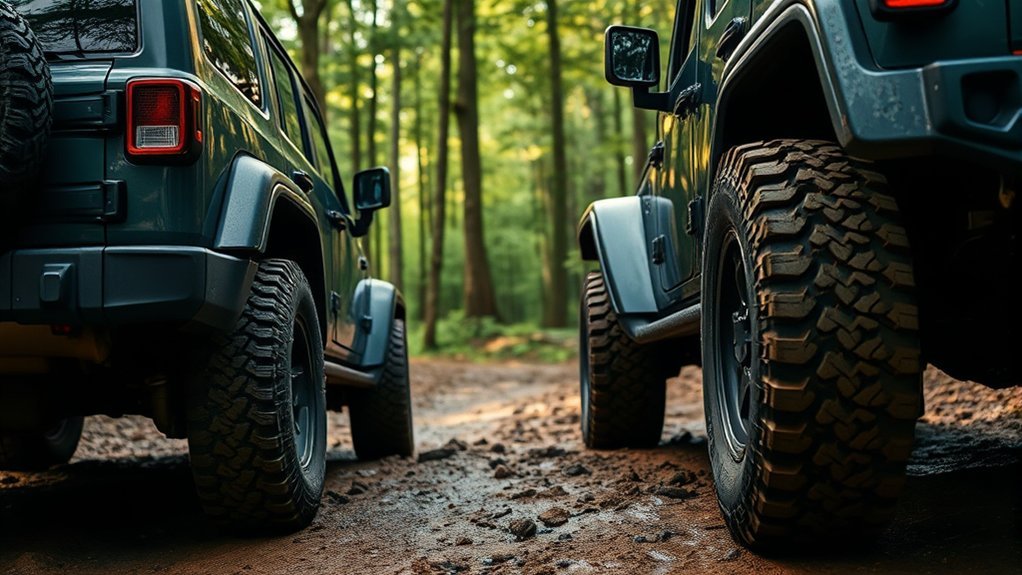
On the other hand, 4WD is usually standard or optional in trucks and larger SUVs built for off-roading, towing, and rugged conditions. Think Jeep Wranglers, Ford Broncos, and Toyota Land Cruisers.
If you need serious off-road capability or heavy hauling, 4WD vehicles are typically your best bet.
How to Choose Between AWD and 4WD for Your Driving Needs
How do you decide which drivetrain suits your lifestyle best? Start by considering your typical driving conditions and needs. AWD offers seamless traction for daily commutes and light off-roading, adapting well to rain and snow.
Consider your driving habits—AWD provides reliable traction for everyday roads and mild off-road conditions.
On the other hand, 4WD excels in rugged terrain and serious off-road adventures, giving you more control when the going gets tough. To make the right choice, ask yourself:
- Do you drive mostly on paved roads or off-road trails?
- How often do you encounter slippery or uneven surfaces?
- Do you need the vehicle for heavy-duty towing or hauling?
- Is fuel efficiency a key priority for you?
Answering these questions will help you pick the drivetrain that matches your driving style perfectly.
Frequently Asked Questions
Can AWD or 4WD Be Added to a Vehicle After Purchase?
You can add AWD or 4WD after purchase, but it’s complex and costly. It involves changing the drivetrain, differentials, and electronics.
Because of this, it’s usually easier and cheaper to buy a vehicle designed with those systems.
How Do AWD and 4WD Systems Impact Vehicle Maintenance Costs?
You’ll likely face higher maintenance costs with AWD and 4WD systems since they have more components like differentials and transfer cases.
Regular fluid changes and inspections are essential to keep them running smoothly and avoid expensive repairs.
Are There Insurance Differences for AWD vs. 4WD Vehicles?
Insurance costs for AWD and 4WD can differ like night and day. You’ll often pay more for 4WD due to higher repair expenses and off-road risks, while AWD usually has slightly lower premiums.
What Are the Historical Origins of AWD and 4WD Systems?
You’ll find 4WD dates back to early 1900s military vehicles for rugged terrain, while AWD emerged later in the 1960s for better on-road traction.
AWD evolved with advanced electronics for everyday driving.
Do AWD and 4WD Systems Affect Tire Wear Differently?
Wonder how your tires handle different terrains? AWD usually causes more even tire wear since it distributes power continuously, while 4WD can lead to uneven wear if you use it on dry pavement or rough surfaces often.
Conclusion
Choosing between AWD and 4WD depends on your driving style and terrain. AWD is like having a trusty steed that adjusts effortlessly on city streets and light trails, giving you confidence year-round.
Meanwhile, 4WD is your rugged knight in shining armor for tough off-road quests. Know when to call on each, and you’ll navigate roads like a pro—whether it’s the modern highway or a dusty, old wagon trail.
Trust your ride to match your adventure, and remember that understanding the difference between All Wheel Drive and 4 Wheel Drive will help you make the best choice for your needs.