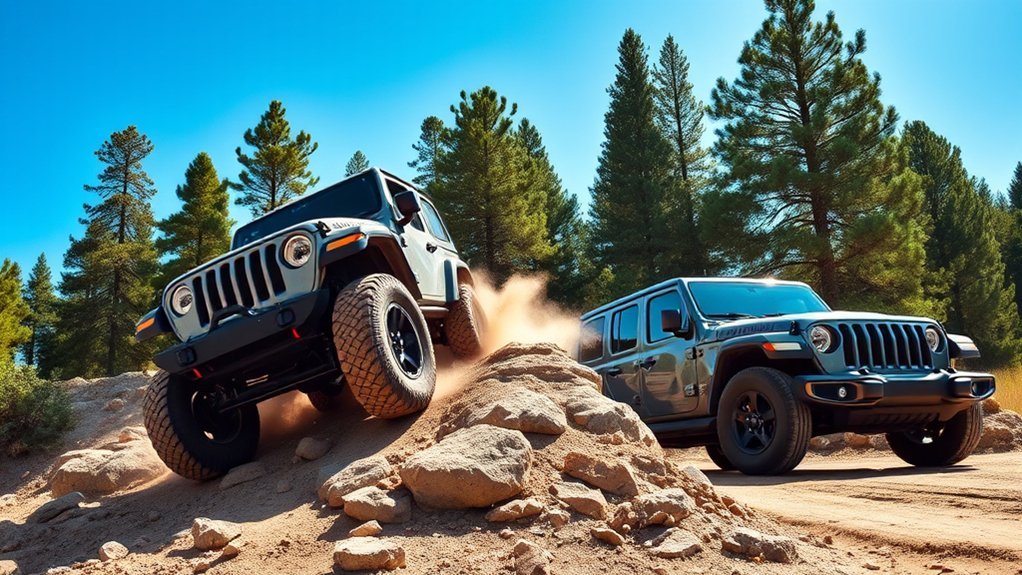
Are All Jeeps 4 Wheel Drive
Not all Jeeps come with four-wheel drive, so are all Jeeps 4 wheel drive? The answer is no—you’ll find many models offering two-wheel drive options to boost fuel efficiency and suit daily city driving.
Some Jeeps, like the Wrangler and Gladiator, have standard 4WD, while others like the Cherokee and Compass give you a choice between 2WD and 4WD.
If you want the best fit for your lifestyle and terrain, understanding these drivetrain options is key. There’s plenty more to explore about how 4WD shapes Jeep performance.
Key Takeaways
- Not all Jeeps come with 4-wheel drive; some models have 2-wheel drive for fuel efficiency and casual use.
- Wrangler and Gladiator models come standard with 4-wheel drive.
- Cherokee, Grand Cherokee, and Compass offer both 2WD and 4WD options depending on trim levels.
- Many Jeep models provide 4WD as an upgrade rather than a standard feature.
- Always verify specific model and trim to confirm if a Jeep has 4-wheel drive.
Do All Jeeps Come With 4-Wheel Drive?
Do all Jeeps come with 4-wheel drive? Not necessarily. While many Jeep models are known for their off-road capabilities and 4WD options, not every Jeep you see is equipped with it.
Some models, especially those designed for city driving or casual use, come with 2-wheel drive to improve fuel efficiency and reduce costs. When you’re shopping for a Jeep, you’ll notice that certain trims come standard with 4WD, while others offer it as an upgrade.
It’s important to check the specific model and trim level to know what drivetrain it has. So, don’t assume every Jeep you encounter has 4-wheel drive. You’ll need to verify before making your decision.
How 4WD Works in Your Jeep
Understanding how 4WD works in your Jeep helps you get the most out of its capabilities. You’ll learn about different types of 4WD systems and how to engage all four wheels when you need extra traction.
Plus, you’ll see the key benefits that make 4WD a valuable feature for off-road and tough driving conditions.
Types Of 4WD Systems
How exactly does 4WD work in your Jeep? It depends on the type of 4WD system it has. Most Jeeps come with part-time 4WD, which lets you switch between 2WD and 4WD as needed.
This system powers all four wheels only when you engage it, saving fuel during regular driving. Some models feature full-time 4WD, which powers all wheels continuously but allows for variable torque distribution, improving traction without driver input.
You might also find advanced systems like Jeep’s Active Drive, which automatically adjusts power between front and rear axles based on terrain. Understanding your Jeep’s 4WD system helps you use it effectively, whether you’re cruising city streets or tackling off-road trails.
Engaging Four Wheels
When you want to switch your Jeep into 4WD, you’ll typically engage the system via a lever, switch, or dial depending on your model. This action connects the front and rear axles, allowing power to flow to all four wheels simultaneously. You might need to stop or slow down, but many newer Jeeps let you shift on the fly. Once engaged, the drivetrain manages torque distribution to maximize traction.
Here’s how you typically engage 4WD:
- Manual Lever: Pull or push a lever to lock the transfer case.
- Electronic Switch: Press a button that activates the 4WD system.
- Rotary Dial: Turn a dial to select different 4WD modes.
Each method ensures your Jeep is ready for tougher terrain or slippery conditions.
Benefits Of 4WD
Why does 4WD matter so much in your Jeep? It gives you enhanced traction by sending power to all four wheels simultaneously, which is crucial when driving on slippery or uneven surfaces.
Whether you’re tackling mud, snow, or rocky trails, 4WD helps maintain control and prevents your Jeep from getting stuck. When you engage 4WD, your Jeep distributes torque evenly, improving grip and stability. This means you can confidently navigate tough terrain without worrying about losing traction.
Additionally, 4WD reduces wheel slippage and enhances your vehicle’s ability to climb steep inclines or descend safely. In short, 4WD transforms your Jeep into a capable off-road machine, giving you peace of mind and the freedom to explore beyond paved roads.
Jeep Models With Standard 4WD vs. 2WD Options
Which Jeep models come with standard 4WD, and which offer 2WD options? If you’re looking for a Jeep with standard 4WD, the Wrangler and Gladiator are your go-to choices. These models come built for off-road adventures, ensuring you have traction no matter the terrain.
On the other hand, some Jeep models give you the option between 2WD and 4WD, letting you choose based on your needs.
Here’s a quick breakdown:
- Jeep Wrangler and Gladiator: Standard 4WD, perfect for off-roading.
- Jeep Cherokee and Grand Cherokee: Offer both 2WD and 4WD options.
- Jeep Compass: Available in both 2WD and 4WD trims for flexibility.
Understanding these options helps you pick the right Jeep for your driving style.
How 4WD Affects Jeep Performance and Handling
How does 4WD change the way your Jeep handles on different terrains? When you engage 4WD, power distributes to all four wheels, boosting traction and control. This makes it easier for you to navigate slippery, rocky, or uneven surfaces without losing grip.
On loose dirt or snow, 4WD helps prevent wheel spin, so you can maintain momentum and avoid getting stuck. However, on dry pavement, 4WD can make steering feel heavier and reduce fuel efficiency.
You’ll notice better stability when climbing hills or crossing obstacles since power balances across wheels, reducing slippage. Overall, 4WD enhances your Jeep’s off-road capability while slightly impacting on-road handling.
Knowing this helps you use 4WD effectively, tailoring performance to the terrain you’re tackling.
Choosing Between 4WD and 2WD Jeeps
When deciding between a 4WD and a 2WD Jeep, you need to contemplate where and how you’ll be driving most often. If you mostly stick to city streets or highways, a 2WD Jeep might be enough for your daily needs. However, if you frequently tackle rough terrain or face challenging weather conditions, 4WD offers better traction and control.
Consider these factors to make your choice:
- Terrain: Does your route include dirt, mud, snow, or rocky paths?
- Weather: Are you dealing with rain, ice, or snow regularly?
- Usage: Do you need your Jeep for off-roading, towing, or just commuting?
Common Myths About Jeep 4WD
Although Jeep’s reputation for rugged 4WD capability is well-earned, many misconceptions still surround their systems. You might think every Jeep automatically comes with full-time 4WD, but that’s not always true. Some models offer part-time or even 2WD options.
Another common myth is that 4WD means better fuel efficiency, but engaging 4WD often lowers it due to extra drivetrain resistance. You may also hear that 4WD is only useful off-road, yet it can improve traction in rain or snow too.
Don’t believe 4WD makes a Jeep unstoppable; driver skill and terrain play huge roles. Understanding these myths helps you appreciate what Jeep’s 4WD really offers and what limitations you should keep in mind when driving.
Tips for Picking the Right Jeep Drivetrain
You’ll want to understand the different Jeep drivetrain options before making a choice. Think about the terrain you’ll face and how you plan to use your Jeep.
Also, keep in mind how each drivetrain affects fuel efficiency.
Understanding Jeep Drivetrain Types
How do you choose the right drivetrain for your Jeep? Understanding the drivetrain types helps you match your vehicle to your needs. Jeep offers several options, each designed for different driving experiences and conditions.
Here’s a quick look at the main types:
Two-Wheel Drive (2WD): Powers either the front or rear wheels. It’s simpler, lighter, and more fuel-efficient but less capable off-road.
Part-Time 4WD: Allows you to switch between 2WD and 4WD, giving you versatility for both city driving and off-road adventures.
Full-Time 4WD: Powers all wheels continuously, providing excellent traction and stability on various terrains without driver input.
Knowing these will help you pick a drivetrain that suits your lifestyle and driving style perfectly.
Consider Terrain And Usage
Where will you drive your Jeep most often? If you plan to tackle rough trails, rocky paths, or snowy roads, a 4-wheel drive system is essential to maintain traction and control. It helps you navigate challenging terrains without getting stuck.
On the other hand, if your driving mostly involves city streets or highways, a 2-wheel drive model can be more practical and cost-effective. Think about how often you’ll encounter mud, sand, or steep inclines.
Also, consider if you’ll use your Jeep for towing, hauling, or off-roading adventures. Matching your drivetrain to your typical terrain and usage ensures you get the performance and reliability you need without unnecessary features that don’t fit your lifestyle. This way, you’ll enjoy your Jeep to the fullest.
Evaluate Fuel Efficiency Impact
Why does fuel efficiency matter when choosing your Jeep’s drivetrain? It directly affects your running costs and how far you can go on a tank. If you plan to use your Jeep daily or for long trips, better fuel economy can save you a lot over time. On the other hand, if off-roading is your priority, you might accept lower efficiency.
Here’s what to consider:
- 4WD systems typically consume more fuel due to added weight and drivetrain complexity.
- Part-time 4WD or 2WD options usually offer better mileage when you don’t need extra traction.
- Advanced systems like Jeep’s fuel-saving tech can balance power and efficiency.
Weigh these factors carefully to pick a drivetrain that fits your lifestyle and budget.
Frequently Asked Questions
Can I Convert a 2WD Jeep to 4WD?
You can convert a 2WD Jeep to 4WD, but it’s complex and costly. You’ll need a transfer case, front axle, and drivetrain modifications.
It’s often easier to buy a factory 4WD Jeep instead.
How Does 4WD Impact Jeep Fuel Efficiency?
You know what they say, “You don’t get something for nothing.” 4WD usually lowers your Jeep’s fuel efficiency because it adds weight and power demand.
Are There Maintenance Differences Between 4WD and 2WD Jeeps?
Yes, you’ll need to perform extra maintenance on 4WD Jeeps, like checking transfer case fluid and differentials more often.
2WD Jeeps require less drivetrain upkeep, so 4WD demands a bit more attention from you.
Do All Jeep 4WD Systems Include Low-Range Gearing?
No, not all Jeep 4WD systems include low-range gearing. Some models, like the Jeep Renegade, offer part-time 4WD without low-range.
Trail Rated models like the Wrangler typically include it for tougher off-road control.
Is 4WD Necessary for City Driving in a Jeep?
You don’t need 4WD for city driving in a Jeep since paved roads usually provide good traction. However, having it can help in slippery conditions like rain or snow, giving you extra control when you need it.
Conclusion
So, you’re wondering if all Jeeps have 4WD? Well, not every Jeep is a rugged mountain conqueror—some prefer the smooth life of 2WD. If you want to channel your inner off-road hero or just avoid getting stuck in a puddle, 4WD’s your best friend.
But hey, if you enjoy the thrill of spinning tires on asphalt, 2WD might just be your jam. Choose wisely, road warrior!
In conclusion, not all Jeeps have 4 wheel drive, so it’s important to check which drivetrain suits your adventures best.